
Furnace for Ceramics Processing and Ceramics Manufacturing
The Stages of Ceramics Processing—and Why Furnace Control Is Critical
Ceramics have come a long way since the days of ancient pottery to sophisticated applications in aerospace, electronics, and biomedical engineering. Behind this innovation is the sophisticated manufacturing process—namely furnace-based heat treatment, which plays a critical role in defining the ultimate shape and performance of the material.
This article will walk you through the most significant steps of ceramics production and explain why precise furnace control—as enabled by advanced systems like those offered by Across International—is essential to creating consistent, high-quality results.
I. The Steps of Ceramics Processing
1. Preparation of Raw Materials
Ceramic processing begins with fine, engineered powders such as:
- Clay minerals (e.g., kaolinite)
- Alumina (Al₂O₃)
- Zirconia (ZrO₂)
- Silicon carbide (SiC)
These powders are blended with plasticizers and binders, and then milled to have uniform particle size. Homogeneity at this stage influences sintering efficiency, grain growth, and final mechanical properties.
2. Forming the Green Body
The ceramic powder mixture is formed into a "green body" using methods such as:
- Cold Isostatic Pressing (CIP)
- Slip casting or tape casting
- Extrusion or injection molding
- 3D printing of ceramic slurries
While these processes form the product geometry, the green body remains weak and porous—needing heat treatment in order to achieve structural strength.
3. Drying
Pre-heating during high-temperature firing, the green body is dried to expel residual water content. It is typically carried out at 100–200°C in drying ovens or low-temperature kilns. Failure in dryness would cause warping or cracking during sintering.
4. Sintering: The Critical Heat Treatment Stage
Sintering converts the green body to a firm, compact ceramic through hot processing—typically between 900°C and over 2000°C, depending on the type.
Typical Sintering Temperatures:
- Alumina: ~1600°C
- Zirconia: ~1450°C
- Silicon Carbide: >2000°C
Phases of Sintering:
- Early Stage: The necking of particles begins
- Middle Stage: Pore shrinking, start of grain growth
- Final Stage: Densification is complete, porosity decreases
Advanced furnace systems (e.g., box or tube furnaces, hot isostatic presses) control heating rate, peak temperature, hold time, and atmosphere, directly affecting the ceramic's microstructure and properties.
5. Cooling and Finishing
After sintering, controlled cooling to avoid thermal stress is necessary. Operations after sintering can be:
- Precision machining
- Surface glazing or polishing
- Structural or performance testing (e.g., porosity, SEM analysis)
II. Why Furnace Control Is Key in Ceramics Manufacturing
1. Sintering Defines Microstructure
Sintering is where the critical properties of a ceramic—such as strength, porosity, and grain structure—are defined. A well-controlled furnace ensures:
- Proper particle bonding
- Maximum densification
- Minimum grain coarsening
Even small changes in the thermal cycle can lead to:
- Weak, porous parts (due to under-sintering)
- Brittle ceramics (due to excessive grain growth)
- Cracking or warping (due to non-uniform heating)
2. Ramp Rate Matters
Different ceramics behave in their own unique manner with thermal expansion. Sudden cooling or heating might impose stresses in the sample causing:
- Delamination or cracking
- Warpage or dimensional change
Precise ramp rates are most important near phase transition zones, e.g., quartz inversion (~573°C). Programmable furnace controllers eliminate such issues.
3. Atmosphere Control Prevents Chemical Degradation
Ceramic properties may be lost unless the furnace atmosphere is controlled:
- Oxidizing conditions will ruin oxygen-sensitive materials
- Inert gases like nitrogen or argon protect against undesired reactions
- Reducing atmospheres are necessary for specialized ceramics and metal oxides
Across International furnaces offer atmosphere control by means of gas inlets and vacuum systems to support an assortment of sophisticated materials.
4. Repeatability = Reliability
In laboratory as well as manufacturing, thermal uniformity is essential. Even ±5°C variation can change:
- Shrinkage behavior
- Crystal phase composition
- Electrical or thermal conductivity
Contemporary PID-controlled furnaces ensure precise temperature tolerances for reliable, reproducible results.
5. Custom Heat Profiles for Specialized Applications
Specialized ceramic types have specific firing requirements:
- Porous ceramics require slow sintering to preserve pore structures
- Technical ceramics such as alumina require precise thermal control at high temperatures
- Glazed ceramics require slow cooling to avoid surface defects
Sophisticated furnace systems allow users to create custom heating profiles to accommodate these unique requirements.
Real-World Example: Alumina Sintering
Alumina typically sinters at ~1600°C. Temperature fluctuations as low as ±50°C can:
- Cause under-sintering (porous, brittle ceramics)
- Cause over-sintering (excessive grain growth, compromised toughness)
Precision furnaces—such as those of Across International—offer control to within ±1–2°C, ensuring the optimal result.
III. Why Choose Across International Furnaces?
Across International (Ai Furnaces) is a trusted name in high-temperature processing, widely used in laboratories, universities, and production environments. When it comes to ceramics manufacturing, especially the critical furnace heat treatment phase (sintering), selecting the right furnace can define the quality, consistency, and performance of the final product. Here's why Across International furnaces are a strong choice:
1. High Temperature Capability
- Models up to 3500°C available
- Perfect for sintering alumina, zirconia, SiC, and other refractory ceramics
2. Programmable Precision
- Multi-segment controllers for advanced profiles
- PID feedback loops for temperature control
- Safety interlocks for real-time monitoring
3. Controlled Atmosphere Options
- Inert gas compatibility (Ar, N₂, H₂)
- Vacuum-compatible versions for oxygen-sensitive materials
4. Perfect for Research & Scale-Up
- Benchtop and pilot-scale models
- Uniform thermal zones for reproducibility
- Configurable for experimental versatility or small-batch manufacturing
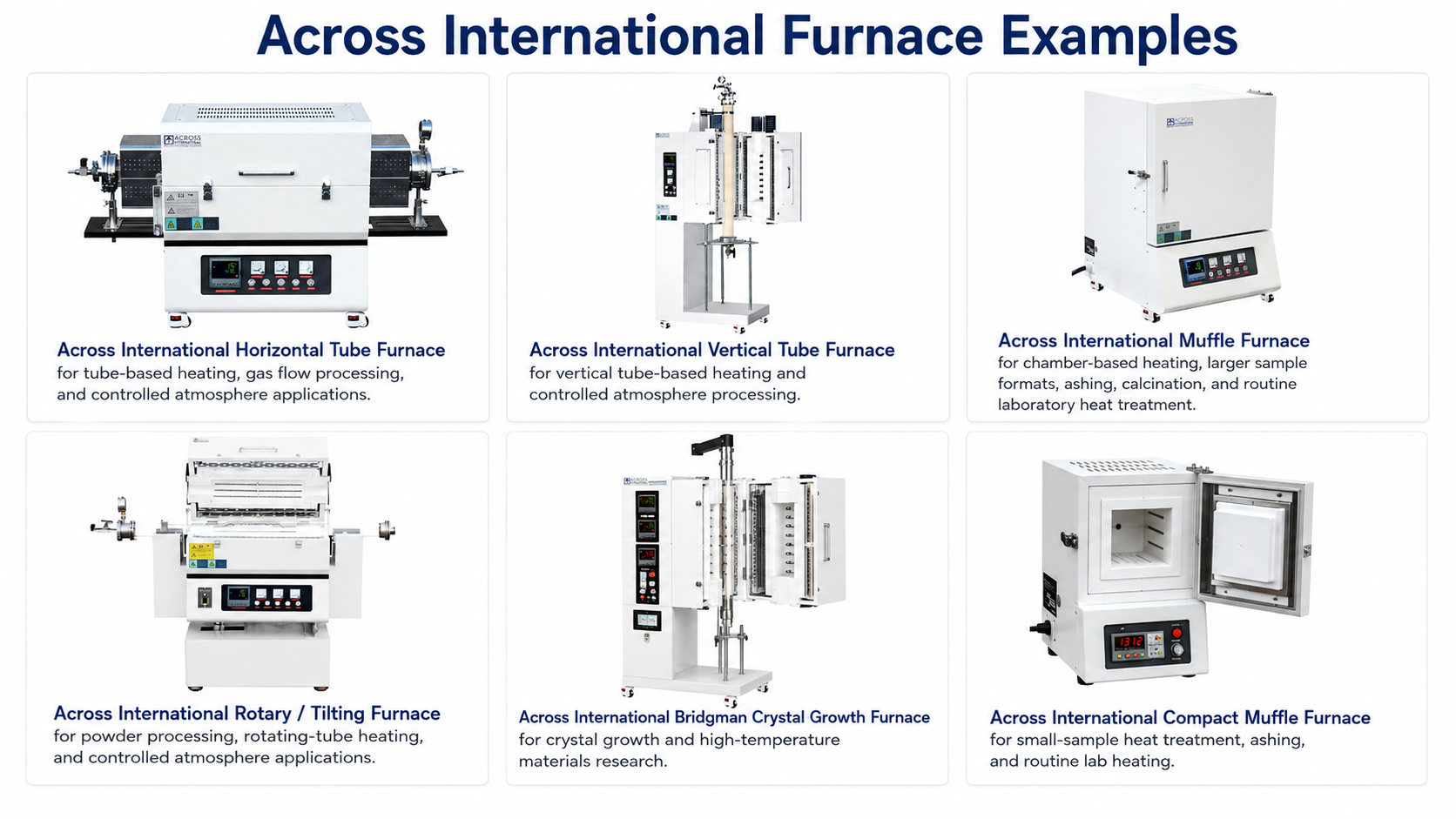
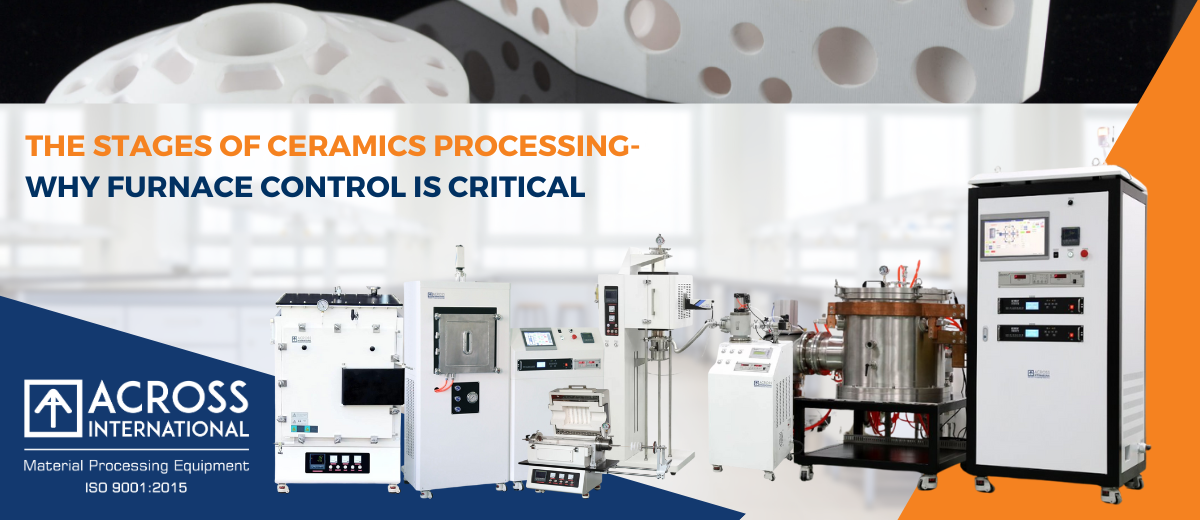
Across International Equipment for Ceramic Processing
|
Furnace Type |
Model Series / Example |
Key Features |
Suitable Ceramic Processes |
|
Box Furnaces |
Max 1800 °C, programmable PID, vacuum/inert gas options |
General sintering, binder burnout, grain coarsening |
|
|
Tube Furnaces |
Horizontal/split, up to 1700 °C, multi-zone uniformity, gas-tight flanges |
Calcination, thermal oxidation, controlled atmosphere sintering |
|
|
Rotary Tube Furnaces |
Continuous powder processing, ideal for granules or flowable ceramics |
Reactive sintering, thermal processing of ceramic powders |
|
|
Fast Sintering Furnaces |
Rapid thermal cycling (up to 100 °C/sec), compact quartz chamber |
Thin films, coatings, electro ceramics |
|
|
Preheating Flash Sintering |
Preheat + electric field activation, MoSi₂ elements, vacuum/inert capable ≤200℃/s |
Ultra-fast densification, field-assisted sintering, SOFCs, high-performance ceramics |
|
|
SPS (Spark Plasma Sintering) |
Up to 2500°C temp up to 50T pressure |
Nanomaterials, conductive ceramics |
Producing ceramics is a science of precision—and furnace control is at the core. From establishing grain structure to enabling complex material behavior, the sintering furnace determines the success of every ceramic component.
With better thermal management, atmosphere flexibility, and scalability, Across International furnaces offer the ideal platform for engineers and researchers who want to advance the boundaries of ceramic performance.