





-
 Trusted ISO 9001 Manufacturer ISO/IEC 17025:2017 certified calibration lab
 -
Trusted by 100K Universities & Companies Over 1000+ Scientific Papers Cited
-
12-hour Technical Support Available Mon–Fri, 8 AM to 8 PM & In-house testing
-
Price Match Matches qualified U.S. competitor prices


Frequently Asked Questions
Got Questions? We’ve Got Answers
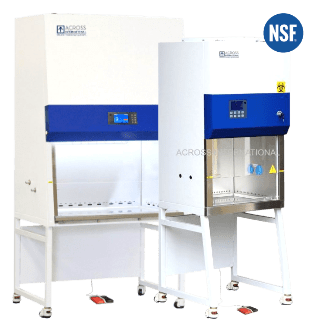
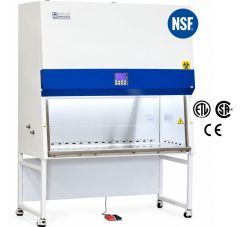
A biosafety cabinet is closed and well-ventilated biological safety equipment which is used in biological laboratories to safely handle biological agents. It uses high frequency particulate air (HEPA)/Ultra-low penetration air (ULPA) and laminar air flow to protect the user, laboratory environment, and research samples from contaminants.
Biosafety cabinet works based on the combined effect of HEPA/ULPA filtration and unidirectional air flow. The air is drawn inward through the front grille at the opening and HEPA filtered air flows vertically upward in order to create safety laboratory workplace.
High frequency particulate air filter can capture 99.97% of aerosols down to 0.3 microns. HEPA filters are capable to capture indoor air pollutants including dust, mold spores, bacteria and certain viruses, pollen etc. They cannot properly trap odors and gases such as volatile organic compounds and chemical fumes. An additional purifier that contains activated carbon filter is required to filter such odors and gases.
Based on efficiency and applications, HEPA filters are classified into different types as follows:
True HEPA filters: Capable of capturing 99.97% of particles ≥ 0.3 microns and are used in cleanrooms, biosafety cabinets, and laboratory and medical equipment.
ULPA filters: Capable of capturing 99.99% of particles ≥ 0.3 microns and are used in semiconductor manufacturing.
Medical Grade HEPA filters: Filters that are especially designed for laboratory and medical environments and used in hospitals, pharmaceuticals, and biosafety cabinets.
Activated Carbon and HEPA combination: Combination of activated carbon and HEPA filters and are used to capture odors and chemicals.
Based on the type of air flow and protection level, biosafety cabinets are classified into class I, class II, and class III, in which class II biosafety cabinets are most common. Class I, protect you and the environment but not the sample, class II protects you, you lab members, sample, and the environment, and class III is also known as glovebox which provides most protection against biological agents.
Depending on the Lavel of biological agents being handled, biosafety cabinets are designed for BSL-1, BSL-2, and BSL-3.
Before choosing a biosafety cabinet, you should look for compliance with NSF/AN SI49, adequate workspace, cost, and reliable HEPA filtration and air flow. Additionally, you may need to consider power requirements and energy saving features.
Fume hood protects users from the fumes of toxic/hazardous chemicals vapors through external air exhaust system whereas biosafety cabinet protect sample, environment, and user from bio contaminants using HEPA filters and unidirectional upward air flow.
To choose best biosafety cabinet for your laboratory, you need to think about space, lab’s risk group, type of exhaust system (ductless vs ducted), air flow patterns, and ventilation system.
According to the Occupational Safety and Health Administration (OSHA), biosafety cabinets are required to be certified at the time of installation and at least once a year. Annual testing ensures filtration and airflow performance meet standards. It is recommended to have a test every six months for pharmacy applications.
A biosafety cabinet must be installed in a stable and vibration-free environment. Proper installation of biosafety cabinet is essential to ensure safe air flow and contamination control. A proper exhaust connection, enough space for air flow, and correct power supply is required. Also, BSC needs to be certified by a qualified technician after installation.
Across Internationals biosafety cabinets offer various features including:
-NSF/ANSI 49 certification
-Dual HEPA filtration system
-Optimized air flow design
-Larger stainless steel work chamber
-Removable work surface and mobile design
-UV sterilization system
-Bright LED illumination
-Safety features
-LCD touchscreen controller
-Low noise operation
The class II A2, and class II B2 biosafety cabinet are mainly different in their airflow design, exhaust system, and level of protection. Class II A2 protects user, sample and environment with partial air recirculation and is commonly used in research laboratories whereas class II B2 biosafety cabinets use 100% external exhaust with no air recirculation and are designed to work involving toxic vapors and hazardous chemicals.