

We use cookies to make your experience better. To comply with the new e-Privacy directive, we need to ask for your consent to set the cookies. Privacy Policy.
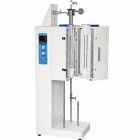
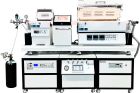
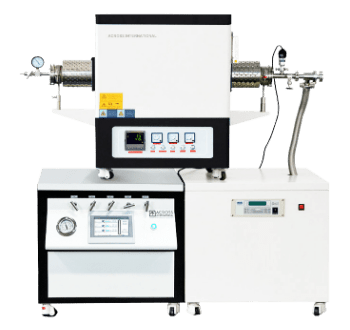
CVD & PECVD furnaces are advanced thermal processing systems used for controlled thin-film deposition, high-purity coatings, nanomaterial synthesis, and atmosphere-sensitive material processing.
A CVD furnace enables chemical vapor deposition by reacting vapor-phase precursor gases at elevated temperatures to form solid films or coatings on a substrate.
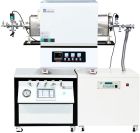
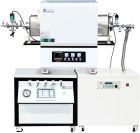
A CVD tube furnace provides a heated tubular process zone with controlled gas flow, temperature stability, and atmosphere management for repeatable deposition conditions.
Unlike conventional thermal CVD, a PECVD system uses plasma to activate chemical reactions at lower process temperatures and can be used to ionize gas for more uniform coating distributions, as well as excite gas species that drive the deposition process. This makes PECVD useful for temperature-sensitive substrates, advanced coatings, and thin-film processes that require plasma-assisted deposition.
CVD & PECVD Furnaces
CVD & PECVD furnaces are advanced thermal processing systems used for controlled thin-film deposition, high-purity coatings, nanomaterial synthesis, and atmosphere-sensitive material processing.
A CVD furnace enables chemical vapor deposition by reacting vapor-phase precursor gases at elevated temperatures to form solid films or coatings on a substrate.
A CVD tube furnace provides a heated tubular process zone with controlled gas flow, temperature stability, and atmosphere management for repeatable deposition conditions.
Unlike conventional thermal CVD, a PECVD system uses plasma to activate chemical reactions at lower process temperatures and can be used to ionize gas for more uniform coating distributions, as well as excite gas species that drive the deposition process. This makes PECVD useful for temperature-sensitive substrates, advanced coatings, and thin-film processes that require plasma-assisted deposition.
Frequently Asked Questions
What is a CVD furnace used for?
A Chemical Vapor Deposition (CVD) furnace is used to deposit thin films and coatings on a substrate through chemical reactions of vapor-phase precursors at high temperatures. In this process, reactive gases are introduced into the furnace, where they decompose or react on the heated substrate surface to form a solid material layer. CVD furnaces are widely used in semiconductor manufacturing, nanomaterials synthesis, such as carbon nanotubes and graphene, thin-film coatings, and protective or functional surface treatments. This technique allows precise control over film thickness, composition, and uniformity.
How does a CVD furnace work?
Gases containing precursor materials are introduced into a heated chamber, where they react or decompose on the substrate surface, forming a solid coating or film.
What materials can be deposited using a CVD furnace?
Chemical Vapor Deposition (CVD) can deposit a wide range of materials, such as metals, including tungsten, metal oxides, carbides, nitrides, and semiconductors such as silicon (Si), silicon oxide, and silicon nitride. It is used for thin films and coatings that require uniformity and high purity.
What are the main applications of CVD furnaces?
Chemical Vapor Deposition (CVD) is widely used in academia and industry for depositing high-quality thin films and coatings through a controlled chemical reaction at high temperatures. The main application areas include thin films and coatings, synthesis of nanomaterials, manufacturing of semiconductors and electronics, preparation of biocompatible thin films and coatings for medical devices, powder metallurgy and high-temperature coatings, and solar cell manufacturing to produce thin-film solar cell materials.
What gases are typically used in CVD processes?
Depending on the application, gases such as methane, hydrogen, ammonia, silane, and other precursor gases are used to achieve specific chemical reactions.
What is the difference between CVD and PVD processes?
CVD relies on chemical reactions of gases to form coatings, while PVD, or physical vapor deposition, uses physical processes like evaporation or sputtering. CVD typically provides better coating uniformity and coverage.
Can a CVD furnace operate under vacuum or controlled atmosphere?
Yes, CVD furnaces often operate under low pressure or in controlled gas environments to ensure precise reaction conditions and film quality.
What temperature range is required for CVD processes?
Temperature requirements vary depending on the material being deposited, but CVD processes generally require elevated temperatures to enable chemical reactions.
What are common challenges in CVD processing?
Typical issues include uneven film thickness, especially on substrates with complex geometry. Precise control of gas flow, pressure, and temperature is important, and small fluctuations can lead to non-uniform film deposition. Proper system design and process control are critical.
What should I consider before choosing a CVD furnace?
Before choosing a CVD furnace, you should ensure it aligns with your precursors, materials, and desired film properties. Important factors include temperature range and uniformity, gas delivery and flow control system, chamber size, substrate size and loading capacity, safety requirements, and compatibility with your target materials and applications.