
We use cookies to make your experience better. To comply with the new e-Privacy directive, we need to ask for your consent to set the cookies. Privacy Policy.
Battery & Fuel Cell
Across International has been supporting battery manufacturers for over 25 years with a wide range of battery manufacturing equipment, including drying ovens, battery furnaces, induction heaters, reactors, and other material processing equipment. Battery manufacturing generally consists of three main stages: electrode manufacturing, cell assembly, and cell finishing.
Within these stages, key processes include slurry mixing and coating, solvent recovery, vacuum drying, packing, and testing. Across International equipment supports a wide range of battery and fuel cell applications, including lithium battery manufacturing, solid-state batteries, hydrogen fuel cells, and other advanced energy storage technologies.
What is a battery?
A battery is a device made to store chemical energy and convert it to electrical energy. The chemical process in a battery cell is essentially a redox reaction where electrons flow from one material, also known as an electrode, to another material, through an external circuit. This flow of electrons runs from the negative terminal, or anode, circulates through the external circuit and then back to the positive terminal, the cathode, creating an electrical current capable of doing work.
Traditionally the term battery refers to a device made of multiple cells, but in modern application the term has been expanded to include single cell batteries. Two main classes of batteries are Primary and Secondary. Primary batteries are also known as single-use or, disposable batteries, and can only be used once. This is due to the electrode materials being irreversibly changed during the discharge process. Popular examples of primary batteries are the alkaline batteries used in traditional flashlights. Secondary batteries are batteries that can be recharged multiple times by means of an applied electrical current. In lead-acid batteries, lithium-ion batteries, and solid-state batteries, the original electrode composition is restored by means of reverse current.
Battery Production and the equipment for success
While the methodology of battery production can vary, the basic materials and processes remain the same. First the electrodes need to be created from raw materials, this normally involves mixing conductive binder with the electrode material to create a slurry like mixture. This slurry is then applied to current collectors, these are usually foils made of differing materials for the cathode and anode. Generally, the anode in Li-ion batteries is made of graphite, while the cathode is an alloy of several metals ( lithium, nickel, cobalt, manganese , and others). Once the electrode coating is complete, the electrodes will undergo compressing, slitting, and finally drying. The cells are dried in order to remove any residual solvent or moisture, the process of drying and solvent recovery is an essential step before moving to cell assembly.
After the electrodes are manufactured, they must be assembled into battery cells. This process involves stacking, winding, packing, welding, and filling. From cell production the battery then moves into its final stages of cell finishing which consist of cell formation, degassing, aging, and EOL tests. In this final stage the batteries are repeatedly charged and drained, tested, inspected, and finally set to their shipping state of charge. The finishing process can take over 3 weeks and is one of the longest portions of the battery production process.
While the methodology of battery production can vary, the basic materials and processes remain the same. Electrodes are first created, then assembled into cells, and finally finished as a complete battery. Across international supplies a range of equipment ideal for stages like mixing, drying, solvent recovery, compressing, and welding. For more information reach out to our technical sales team.
Across International has been supporting battery manufacturers for over 25 years with a wide range of battery manufacturing equipment, including drying ovens, battery furnaces, induction heaters, reactors, and other material processing equipment. Battery manufacturing generally consists of three main stages: electrode manufacturing, cell assembly, and cell finishing.
Within these stages, key processes include slurry mixing and coating, solvent recovery, vacuum drying, packing, and testing. Across International equipment supports a wide range of battery and fuel cell applications, including lithium battery manufacturing, solid-state batteries, hydrogen fuel cells, and other advanced energy storage technologies.
What is a battery?
A battery is a device made to store chemical energy and convert it to electrical energy. The chemical process in a battery cell is essentially a redox reaction where electrons flow from one material, also known as an electrode, to another material, through an external circuit. This flow of electrons runs from the negative terminal, or anode, circulates through the external circuit and then back to the positive terminal, the cathode, creating an electrical current capable of doing work.
Traditionally the term battery refers to a device made of multiple cells, but in modern application the term has been expanded to include single cell batteries. Two main classes of batteries are Primary and Secondary. Primary batteries are also known as single-use or, disposable batteries, and can only be used once. This is due to the electrode materials being irreversibly changed during the discharge process. Popular examples of primary batteries are the alkaline batteries used in traditional flashlights. Secondary batteries are batteries that can be recharged multiple times by means of an applied electrical current. In lead-acid batteries, lithium-ion batteries, and solid-state batteries, the original electrode composition is restored by means of reverse current.
Battery Production and the equipment for success
While the methodology of battery production can vary, the basic materials and processes remain the same. First the electrodes need to be created from raw materials, this normally involves mixing conductive binder with the electrode material to create a slurry like mixture. This slurry is then applied to current collectors, these are usually foils made of differing materials for the cathode and anode. Generally, the anode in Li-ion batteries is made of graphite, while the cathode is an alloy of several metals ( lithium, nickel, cobalt, manganese , and others). Once the electrode coating is complete, the electrodes will undergo compressing, slitting, and finally drying. The cells are dried in order to remove any residual solvent or moisture, the process of drying and solvent recovery is an essential step before moving to cell assembly.
After the electrodes are manufactured, they must be assembled into battery cells. This process involves stacking, winding, packing, welding, and filling. From cell production the battery then moves into its final stages of cell finishing which consist of cell formation, degassing, aging, and EOL tests. In this final stage the batteries are repeatedly charged and drained, tested, inspected, and finally set to their shipping state of charge. The finishing process can take over 3 weeks and is one of the longest portions of the battery production process.
While the methodology of battery production can vary, the basic materials and processes remain the same. Electrodes are first created, then assembled into cells, and finally finished as a complete battery. Across international supplies a range of equipment ideal for stages like mixing, drying, solvent recovery, compressing, and welding. For more information reach out to our technical sales team.
Laboratory Furnaces
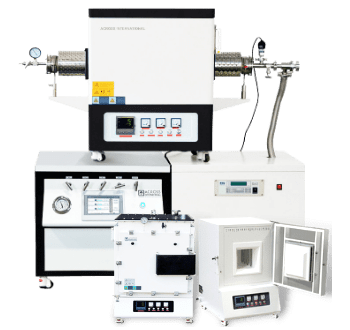
Lab furnaces are used for controlled high-temperature processing in laboratories, universities, R&D facilities, pilot-scale environments, and industrial production. They support processes such as drying, ash testing, calcination, annealing, sintering, heat treatment, brazing, and advanced materials development.
A laboratory furnace is typically selected for precise temperature control, repeatable heating profiles, high-purity chamber materials, sample testing, and process development at a smaller scale than full industrial production.
Across International offers heat treatment furnaces and other thermal processing systems for materials science, metallurgy, ceramics, battery research, electronics, aerospace, nanotechnology, semiconductor research, and advanced manufacturing.
Key Features:
- Mitsubishi-high grade alumina ceramic and fiber
- High performance Kanthal heating elements
- Eurotherm multi-segment PID controller with RS232 interface for data logging and remote operation
- Quartz and Ceramic tube options, up to 250 mm OD
- Built-in over-temperature and safety cutoffs
- CE and ETL certified
Laboratory Ovens
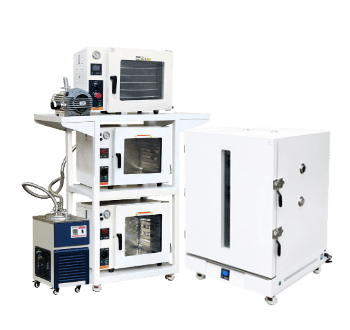
The Vacuum Oven, and Forced air oven, are not only an essential part of every laboratory, but also integral to countless applications across varying sectors. From baking and food processing to material testing, all the way to semiconductor and metallurgy, our ovens can be found across the world supporting researchers and processers alike. With over 25 years of knowledge and innovations, Across International leads the industry in precise and reliable oven technology.
- Multi zone heating for precise temperature control
- 3" of insulation around the chamber for increased temperature stability and efficiency
- New tention-adjustable door handles
- UL/CSA certified, CE certified, cGMP ready