
Lab Sample Preparation Guide: Mills and Grinders
Reliable analytical results start with proper sample preparation. Before a sample reaches an analytical instrument, it often needs to be dried, milled, homogenized, or reduced to a specific particle size. If this step is inconsistent, the final data may be affected by poor sample representativeness, contamination, material overheating, or incomplete extraction.
For laboratory work, the goal is not simply to make particles smaller. The goal is to preserve the sample’s relevant properties and prepare material that is suitable for the next analytical step. The same material may require a different preparation approach depending on whether the goal is XRF or XRD powder preparation, active compound extraction, biological tissue homogenization, pharmaceutical blending, or hard mineral grinding.
The right mill or grinder depends on sample hardness, moisture, oil content, brittleness, heat sensitivity, target particle size, contamination risk, and acceptable wear of contact parts. This guide explains how to choose a laboratory mill or grinder based on sample behaviour, process requirements, and downstream analysis needs.
Table of Contents
- Why Sample Preparation Matters
- How to Choose a Mill by Sample Type and Process
- Quick Comparison: Mill Type vs. Sample Type
- How to Refine Mill Selection for a Specific Application
- Laboratory Sample Preparation Workflow
- Cleaning and Maintenance Best Practices
- Lab Mills and Grinders from Across International
- Frequently Asked Questions (FAQs)
Key Takeaways
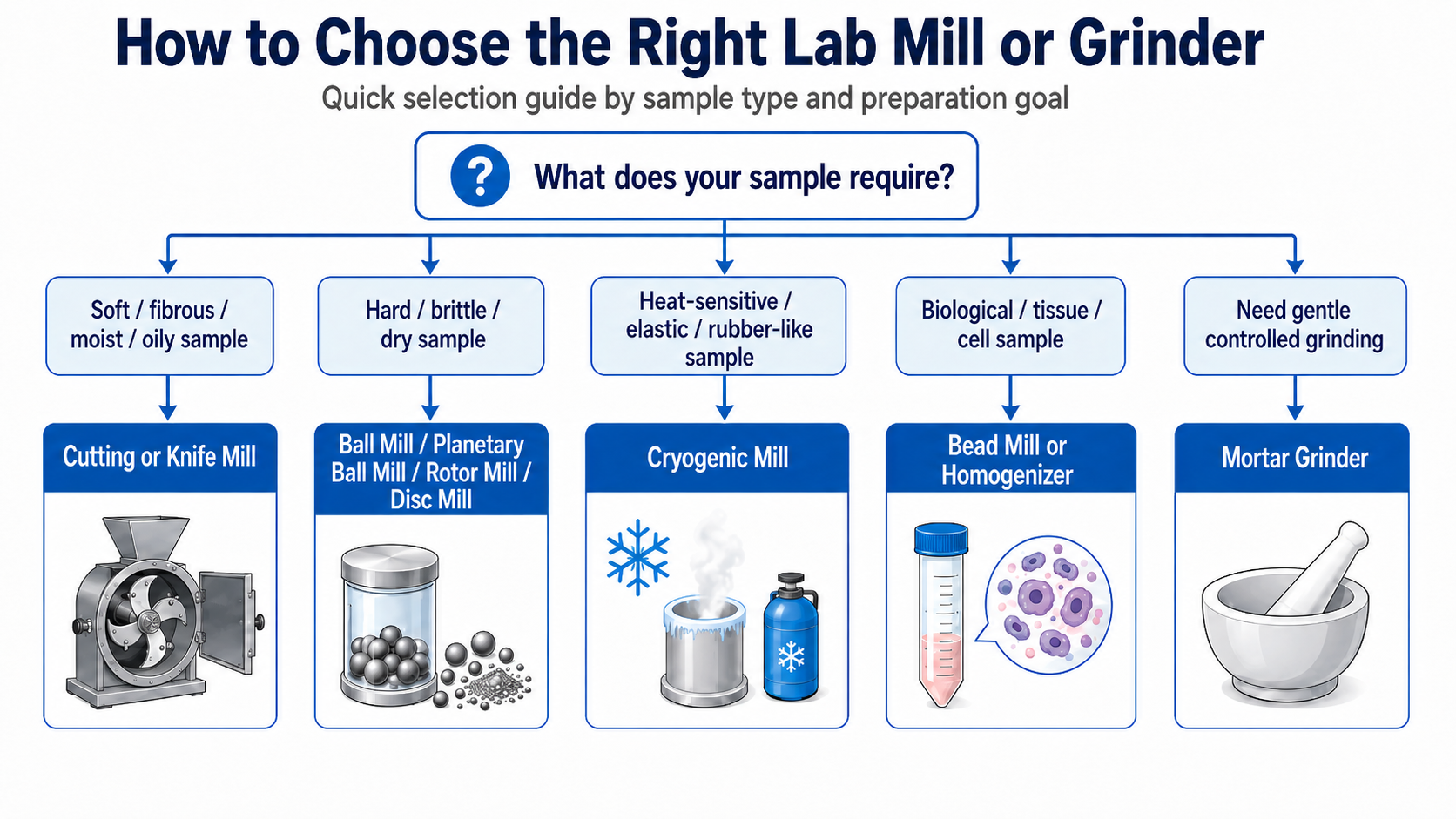
- Choose a mill based on how the sample behaves during grinding, not only on the desired particle size
- Cutting and knife mills are often better for soft, fibrous, moist, or oily materials
- Ball mills, planetary ball mills, rotor mills, and disc mills are commonly used for hard and brittle samples
- Cryogenic grinding may be required for elastic, rubber-like, sticky, or heat-sensitive materials
- Bead mills and homogenizers are often useful for small-volume biological samples
- Mill selection should consider grinding efficiency, heat generation, contamination risk, media wear, cleaning requirements, and process reproducibility
- Proper cleaning between runs and regular inspection of worn components help ensure reliable and repeatable analytical results
Why Sample Preparation Matters
Sample preparation is one of the most critical steps in the analytical process. Even a precise analytical method cannot compensate for a sample that is poorly milled, non-homogeneous, contaminated, or changed during preparation.
The main purpose of sample preparation is to produce material that represents the original sample and fits the next analytical step. Some methods require a fine and uniform powder. Others require preserving volatile compounds, avoiding heat buildup, preventing metal contamination, or achieving reproducible homogenization.
Milling is especially important when the original material is too coarse, too heterogeneous, or made of different phases. Reducing particle size increases surface area, improves access for solvents or reagents, and helps produce more stable results when a small portion of the original material is analyzed.
How to Choose a Mill by Sample Type and Process
Different mills are not only different in design. They also apply different mechanical forces: impact, cutting, compression, friction, or a combination of these mechanisms. For practical selection, it is more useful to connect each mill type directly with suitable samples, process advantages, and limitations.
Cutting and Knife Mills
Cutting and knife mills both use blades, but they are not always interchangeable.
Cutting mills usually reduce material by shearing it between moving and fixed cutting elements. They are useful for fibrous, elastic, and structured samples that need to be cut rather than fractured by impact. Common examples include biomass, plastics, rubber, leather, textiles, and plant materials.
Knife mills are typically used for fast homogenization of soft, moist, fatty, or heterogeneous samples. Their design is often more practical for food products, fresh plant tissue, high-moisture samples, high-fat samples, and materials that may smear or clog enclosed grinding systems.
The main advantage of cutting and knife mills is their ability to process soft, moist, and fibrous materials that do not respond well to impact grinding. These mills are less likely to compact or smear certain materials compared with some closed grinding systems.
Their main limitation is that they are not suitable for very hard, brittle, or abrasive materials. Minerals, glass, ceramics, and hard composites can damage blades or reduce cutting efficiency.
Ball Mills
Ball mills grind samples in closed jars using grinding balls. As the jar moves, the balls collide with the sample and reduce particle size through impact and friction.
They are well suited for dry, hard, and brittle materials that need to be reduced into finer powders. Ball mills are often used for minerals, ceramics, glass, dried plant materials, pharmaceutical powders, chemical materials, and some materials research applications.
The main advantage of a ball mill is versatility. It can process a wide range of hard materials and can support fine grinding when the jar, grinding balls, time, and operating mode are properly selected.
The main limitations are heat generation, wear, and possible contamination. If the grinding jar or balls are not selected correctly, the sample may be contaminated by steel, ceramic, tungsten carbide, or another contact material. This can be critical for sensitive analytical workflows.
Planetary Ball Mills
Planetary ball mills also use grinding balls, but they operate with higher grinding energy than standard ball mills. The jars rotate on their own axes while also moving around a central path, creating more intense collisions between the balls and the sample.
These mills are useful for more intensive fine grinding, preparation of very fine powders, materials research, ceramics, pharmaceutical materials, metal powders, and samples that require a high degree of dispersion.
The main advantage of planetary ball mills is high grinding energy and the ability to reach smaller particle sizes faster than many conventional ball mills.
The main limitation is that the process requires tighter control. High energy can lead to heat buildup, particle agglomeration, media wear, or changes in sample properties. Users should carefully evaluate cycle time, pauses, ball-to-sample ratio, jar material, and grinding media.
Rotor Mills
Rotor mills use high-speed rotor movement. Depending on the design, they can combine impact and shearing forces. This makes them useful for soft, medium-hard, brittle, or fibrous materials.
Rotor mills are often used for grains, seeds, chemical materials, polymers, plant materials, some food products, and samples that need fast size reduction before further analysis.
Their advantage is speed and throughput. They can be practical when a lab needs to prepare a series of samples quickly.
Their limitations depend on sample behavior. Sticky, moist, oily, or very light samples may clog the system, feed poorly into the working area, or pass unevenly through a sieve. Abrasive materials can also accelerate rotor and sieve wear.
Disc Mills
Disc mills grind material between two discs. Unlike ball mills, where the process is based mainly on ball impacts, disc mills rely on pressure, shearing, and abrasion between disc surfaces.
They are suitable for medium-hard, hard, and brittle materials, including minerals, ores, chemical materials, grains, ceramics, and industrial samples. Disc mills can be useful when a lab needs uniform size reduction before additional preparation or analysis.
The main advantage of disc mills is stable mechanical grinding and good performance with hard materials that are not too sticky or elastic.
The main limitation is disc wear when processing abrasive materials. Disc mills may also be less suitable for sticky, wet, or elastic samples that do not move cleanly between the grinding surfaces.
Mortar Grinders
Mortar grinders use pressure and friction between a mortar and pestle. Compared with ball mills or planetary mills, they provide gentler and more controlled grinding.
They are useful for small laboratory batches, pharmaceutical powders, moist or brittle samples, pasty materials, and applications where reproducible preparation is needed without aggressive impact.
The main advantage of mortar grinders is control. They are useful when the sample needs to be prepared carefully without excessive heat or strong impact.
The main limitation is lower throughput. Mortar grinders are usually not the best choice for high-throughput workflows, very hard materials, or applications that require very fine powder in a short time.
Cryogenic Mills
Cryogenic mills are used when a material is difficult to grind at room temperature. Elastic, rubber-like, sticky, or heat-sensitive samples may deform, smear, soften, or melt during standard grinding. Cooling with liquid nitrogen makes these materials more brittle and easier to fracture.
Cryogenic grinding may be useful for rubber, polymers, plastics, biological tissue, heat-sensitive compounds, pharmaceutical materials, and samples that lose properties when exposed to heat.
The main advantage of cryogenic milling is that it enables processing of materials that otherwise grind poorly. This is especially important when users need to preserve chemical composition, avoid overheating, or produce a clean brittle fracture.
The limitations are related to safety, cost, and workflow setup. Liquid nitrogen requires proper handling, compatible containers, and attention to temperature changes. Users should also consider condensation risk and whether cooling may affect the sample.
Bead Mills and Homogenizers
Bead mills and homogenizers use small beads that move at high speed and disrupt the sample through collisions. They are especially useful for small-volume biological, cellular, and tissue samples.
These systems are often used for tissue homogenization, cell disruption, biological sample preparation, molecular biology workflows, and high-throughput processing of small samples in tubes.
The main advantage is efficient processing of small volumes and the ability to prepare multiple samples in parallel. This is useful for labs working with biological materials or sample series.
The limitations depend on bead selection, sample volume, tube format, and operating mode. Larger beads may work better for dense structures, while smaller beads may be better for cellular material. Poor bead selection can reduce homogenization efficiency or increase contamination risk.
Quick Comparison: Mill Type vs. Sample Type
|
Mill Type |
Best For |
How It Works |
Main Advantage |
Main Limitation |
|
Cutting Mill |
Fibrous, elastic, structured materials |
Cuts material between cutting elements |
Works well with materials that are difficult to fracture by impact |
Not suitable for very hard or abrasive samples |
|
Knife Mill |
Moist, soft, fatty, heterogeneous samples |
Rapidly cuts and homogenizes material with blades |
Practical for food, plant, and high-moisture samples |
Not suitable for minerals, glass, or ceramics |
|
Ball Mill |
Dry, hard, brittle materials |
Uses impact and friction from grinding balls |
Versatile for fine grinding of hard samples |
Can generate heat; grinding media may contaminate the sample |
|
Planetary Ball Mill |
Very fine and high-energy grinding |
Creates intense collisions between balls and sample |
Reaches smaller particle sizes faster |
Requires careful parameter control |
|
Rotor Mill |
Soft, medium-hard, brittle, or fibrous samples |
Uses a high-speed rotor, impact, and shearing |
Fast processing and good throughput |
Sticky or lightweight samples may feed poorly |
|
Disc Mill |
Medium-hard, hard, and brittle materials |
Grinds between two discs through pressure and abrasion |
Good for uniform size reduction |
Discs may wear with abrasive materials |
|
Mortar Grinder |
Small batches, moist, brittle, or pharmaceutical samples |
Uses pressure and friction between mortar and pestle |
Gentle and controlled grinding |
Lower throughput |
|
Cryogenic Mill |
Elastic, sticky, rubber-like, heat-sensitive materials |
Cools the sample and makes it brittle before grinding |
Enables grinding of materials that perform poorly at room temperature |
Requires liquid nitrogen handling |
|
Bead Mill / Homogenizer |
Small-volume biological samples |
Uses collisions from small beads |
Effective for tissues, cells, and sample series |
Beads, tubes, and operating mode must match the sample |
How to Refine Mill Selection for a Specific Application
After identifying the likely equipment type, the next step is to refine the process. Many preparation problems happen at this stage: a technically suitable mill may still fail if contamination, heat, moisture, or analytical requirements are not considered.
Decide What Matters Most: Particle Size, Homogeneity, or Sample Integrity
Not every application requires the finest possible powder. In some cases, it is more important to preserve chemical composition, avoid heat buildup, or achieve stable homogenization without damaging sensitive components.
For example, XRF or XRD analysis may require a fine and uniform powder. Biological samples may require effective tissue or cell disruption. Heat-sensitive compounds may require temperature control. Trace analysis may require minimizing contamination from contact materials.
Account for Moisture, Oil Content, and Stickiness
Moist, fatty, or sticky materials often behave unpredictably. They may cling to the chamber walls, clog screens, smear across the working area, or form clumps.
Possible solutions include:
- Pre-drying the sample
- Cooling the sample before grinding
- Using a knife or cutting mill
- Reducing the sample load
- Using shorter grinding cycles
- Adding pauses between grinding cycles
- Cleaning the mill between repeated runs
- Reducing the grinding speed when heat buildup is an issue
- Using cryogenic grinding for heat-sensitive or elastic materials
- Selecting a different grinding tool or media based on the sample properties
- Allowing the mill and sample to cool between batches
Control Heat Buildup
Many mills generate heat. This matters for polymers, pharmaceutical materials, biological samples, volatile compounds, and materials that soften as temperature rises.
To reduce heat-related problems, users can consider:
- Using shorter grinding cycles
- Adding pauses between grinding cycles
- Cooling the sample before or during grinding
- Using cryogenic grinding for heat-sensitive materials
- Using less aggressive grinding settings
- Reducing the sample load
- Selecting suitable grinding media
- Reducing grinding speed when excessive heat is generated
- Allowing the mill and sample to cool between batches
- Using temperature-sensitive processing methods when necessary
Select Contact Materials for the Analysis
The material of jars, balls, discs, knives, or beads can affect the result. If the analysis is sensitive to metals, steel components may be a problem. If the sample is abrasive, softer contact parts may wear quickly.
Evaluate:
- Sample hardness
- Abrasiveness
- Chemical compatibility
- Trace contamination risk
- Acceptable wear level
- Downstream analytical requirements
- Grinding media compatibility
- Potential for cross-contamination
- Required sample purity
- Cleaning and maintenance requirements
- Expected media and component lifespan
Avoid Overloading the Mill
Excessive sample loading reduces grinding efficiency and hurts reproducibility. Material may move poorly inside the working area, overheat, agglomerate, or grind unevenly.
A controlled load with repeatable parameters is usually better than trying to speed up preparation by adding too much material at once.
Laboratory Sample Preparation Workflow
A good sample preparation process should be consistent, documented, and aligned with the analytical goal.
1. Define the Analytical Goal
Start by defining what the prepared sample needs to achieve. The workflow will differ for chemical analysis, particle size measurement, extraction, spectroscopy, quality control, or materials research.
Clarify:
- Required particle size
- Required homogeneity
- Sample amount
- Acceptable contamination level
- Heat sensitivity
- Moisture requirements
- Downstream analytical method
- Required processing time
- Batch size and throughput
- Need for dry or wet grinding
- Desired reproducibility between runs
- Cleaning requirements between samples
- Material recovery requirements
- Need for inert or controlled atmosphere processing
2. Pre-Treat the Sample
Some materials require pre-treatment before grinding. This may include drying, cooling, cutting, sample division, removing large inclusions, or embrittlement.
Examples:
- Moisture-rich plant samples may require pre-drying
- Elastic polymers may require cryogenic cooling
- Large sample pieces may require pre-cutting
- Heterogeneous samples may require sample division before grinding
- Fatty or oily materials may require special grinding conditions to prevent smearing
- Heat-sensitive samples may require cooling before processing
- Sticky materials may require shorter grinding cycles or lower processing temperatures
- Hard, brittle samples may benefit from preliminary crushing
- Samples with high moisture content may require moisture adjustment before grinding
- Contamination-sensitive samples may require dedicated grinding tools or media
Pre-treatment helps improve grinding efficiency, reduce heat buildup, minimize contamination, and improve consistency between runs.
3. Select the Mill and Contact Materials
Choose the mill type based on sample behaviour. Then select jars, blades, discs, balls, beads, or other contact parts based on hardness, chemical compatibility, and contamination risk.
For sensitive applications, avoid materials that may introduce interfering elements. For example, metal grinding media may not be appropriate if trace metal contamination would affect the result.
4. Set Grinding Parameters
Grinding parameters should be adjusted through testing. A setting that is too gentle may not reach the required particle size, while an overly aggressive setting may overheat or damage the sample.
Important parameters include:
- Speed
- Grinding time
- Cycle duration
- Pauses between cycles
- Sample loading volume
- Ball-to-sample ratio
- Ball or bead size
- Sieve size
- Cooling method
- Contact material
- Grinding media type
- Feed particle size
- Target particle size
- Number of grinding cycles
- Temperature control
- Wet or dry grinding conditions
- Atmosphere requirements
- Sample recovery efficiency
- Contamination tolerance
- Equipment capacity and throughput
5. Check the Result
After grinding, check whether the sample is suitable for the next step. Depending on the workflow, this may involve visual inspection, sieving, particle size measurement, homogeneity checking, or analytical verification.
If the result is inconsistent, adjust more than grinding time alone. Revisit the mill type, sample load, contact materials, cooling, or pre-treatment.
6. Clean the Equipment
Clean the mill immediately after use, especially when switching between different sample types. Residual material can contaminate the next run and reduce confidence in the results.
Cleaning and Maintenance Best Practices
Cleaning and maintenance directly affect reproducibility, contamination control, and equipment performance.
Clean Between Sample Runs
After each run, remove visible residue from all sample-contact surfaces. Depending on mill type, this may include the chamber, jar, lid, blades, screens, grinding balls, tubes, beads, seals, and collection vessels.
Cleaning may involve:
- Disassembly of contact parts
- Dry brushing or wiping
- Use of compressed air, where appropriate
- Solvent rinsing
- Water rinsing, when compatible
- Thorough drying before the next run
- Removal of residual powder or sample buildup
- Cleaning of grinding jars, blades, sieves, and media
- Inspection of hard-to-reach contact surfaces
- Use of dedicated cleaning tools for contamination-sensitive samples
- Verification that no residue remains before reassembly
- Proper reassembly before the next grinding cycle
Prevent Cross-Contamination
Cross-contamination can occur when particles from one sample remain inside the grinding chamber, on the grinding media, in screens, or in hard-to-reach areas.
To reduce carryover:
- Clean all contact surfaces carefully
- Process samples from lower concentration to higher concentration where possible
- Use dedicated accessories for sensitive samples
- Run a blank or sacrificial sample when needed
- Verify cleanliness visually or through rinse testing for critical workflows
- Remove residual powder from jars, blades, sieves, and grinding media
- Allow cleaned components to dry completely before reuse
- Use separate grinding media for contamination-sensitive materials
- Inspect seals, corners, and other areas where residue may accumulate
- Document cleaning procedures for repeatable laboratory workflows
- Replace heavily worn or contaminated contact parts when necessary
- Use validated cleaning methods for high-purity or trace-analysis applications
Inspect Component Wear
Mill components wear over time. Worn parts can reduce grinding efficiency, increase contamination risk, or cause inconsistent particle size results.
Inspect:
- Blades
- Screens
- Grinding jars
- Grinding balls
- Discs
- Beads
- Seals
- Lids
- Safety interlocks
- Moving parts
- Bearings and drive components
- Clamps and locking mechanisms
- Grinding chambers and contact surfaces
- Gaskets and O-rings
- Motors and ventilation openings
- Electrical connections and controls
- Signs of excessive wear, cracking, or corrosion
Replace damaged or worn parts before they affect sample quality, grinding performance, safety, or equipment reliability.
Document the Workflow
For regulated or repeatable workflows, document key parameters:
- Sample type
- Sample amount
- Mill type
- Contact materials
- Grinding speed
- Grinding time
- Number of cycles
- Cycle duration and pause intervals
- Grinding media type and size
- Sample loading volume
- Cooling method
- Cleaning method
- Inspection notes
- Maintenance or part replacement history
- Final particle size or acceptance criteria
- Operator and processing date, when required
- Any deviations from the standard procedure
Clear documentation improves reproducibility, supports quality control, and makes troubleshooting easier.

Lab Mills and Grinders from Across International
Across International offers laboratory equipment for sample preparation, grinding, mixing, and material processing. The right system depends on sample hardness, moisture content, target particle size, throughput, heat sensitivity, and acceptable contamination level.
For hard, brittle, dry, or fine-grinding applications, users can review Across International’s Ball Mills & Mixing category. This section includes planetary ball mills, high-energy ball mills, dual asymmetric centrifugal mixers, high-torque mixers, and overhead stirrers for particle size reduction, homogenization, and mixing applications. Across International also provides dedicated Planetary Ball Mills and High Energy Ball Mills for more intensive milling needs.
For applications where contact material selection is critical, users can also review Jars and Parts, including grinding jars and grinding media options. Contact material selection is especially important when sample purity, abrasion resistance, or trace contamination risk may affect the final analytical result.
Across International can help evaluate sample properties, process requirements, and downstream analysis needs to recommend a suitable mill, mixer, grinding jar, or grinding media configuration.
Contact Across International to discuss laboratory milling, grinding, mixing, particle size reduction, homogenization, and reproducible sample preparation workflows.
FAQs
Which mill is best for soft or fibrous samples?
Cutting and knife mills are often suitable for soft or fibrous samples. Cutting mills are better for structured and fibrous materials, while knife mills are often more practical for soft, moist, or heterogeneous samples.
Which mill is best for hard or brittle samples?
Ball mills, planetary ball mills, disc mills, and some rotor mills are often suitable for hard or brittle materials. The specific choice depends on target particle size, sample abrasiveness, contamination risk, and acceptable heat buildup.
When should cryogenic grinding be used?
Cryogenic grinding should be considered when the sample is elastic, sticky, rubber-like, heat-sensitive, or likely to soften during standard grinding. Cooling makes the material more brittle and easier to fracture.
How can cross-contamination be prevented during grinding?
Cross-contamination can be reduced by cleaning sample-contact surfaces between runs, using compatible grinding media, processing samples in a logical order, using dedicated accessories for sensitive materials, and running blank or sacrificial samples when needed.