

For want of a gauge, the reading was wrong.
For want of the proper reading, the vacuum was blamed.
For want of certainty, a leak was suspected, operations suspended.
For want of proof, a technician was dispatched.
For want of a simple test, irreplaceable hours, days were lost.
For want of preparation, unwanted costs accumulated.
For want of a spare gauge… an entire service trip was made.
And all for the want of a vacuum gauge...
This true tale of a technician called out to service a vacuum heat treatment system that appeared unable to reach its specified vacuum level could have been entirely avoided with the simple stock of a single calibrated on-site testing vacuum gauge.
The mechanical vacuum gauge on the system showed poor performance. The assumption was a system leak, and the gauge itself was not suspected until a full Helium leak test was conducted and proved to deliver perfect performance.
Flights were booked. Time was blocked. Resources deployed. Production schedules were disrupted.
And then, on site, the truth emerged.
The vacuum system was in mint condition.
The pumps hummed ideal high vacuum.
The seals did not yield and held fast to their housings.
The mechanical vacuum gauge had failed.
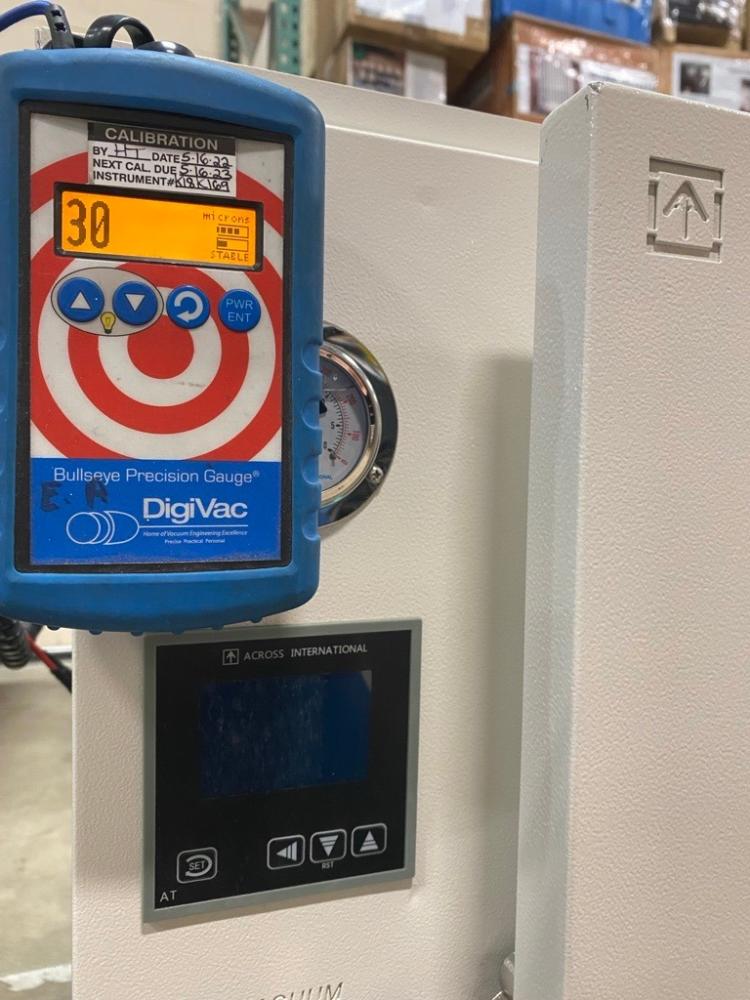
Had a spare digital vacuum gauge been available, something as simple and portable as a DigiVac Bullseye or an Agilent PCG gauge, each in stock & ready to ship from Across International, the entire situation could have been resolved in minutes. A quick cross-check would have confirmed that the system vacuum was healthy and the problem was limited to the gauge itself.
No travel. No downtime. No unnecessary expense. Problem solved before it even happened. Also essential for success with any vacuum gauge: a regular NIST-traceable calibration, another service available from your partners in compliance and success at Across International.
Why This Happens More Often Than You Think
Mechanical gauges:
- Generally provide less accurate reading with a dial, rather than a digital read-out
- Drift over time
- Are sensitive to vibration and contamination
- Often fail silently
- Are frequently trusted without verification
- And cannot be calibrated or set to adjust for barometric pressure and altitude of installation
Digital vacuum gauges, by contrast:
- Provide accurate, easy to read and repeatable readings
- Are portable, simple to deploy and can read in multiple vacuum units for your selection of the ideal reading measurement, easy to match to reference papers SOPs and existing resources
- Allow rapid troubleshooting and easy calibration to ensure accurate reading and repeatable results
- Serve as a trusted second opinion where reliability is key
Across International offers NIST-traceable vacuum calibration, and we may schedule this, as well as regular ISO 17025 calibration into your after-sales maintenance orders!
To add an additional level of control, valves can be incorporated to allow for programmable vacuum levels and ramps, with a controller triggering either isolation vs. exposure to the vacuum pumping system, and/or vent valves to allow atmosphere, inert or reactive gases back into the system.
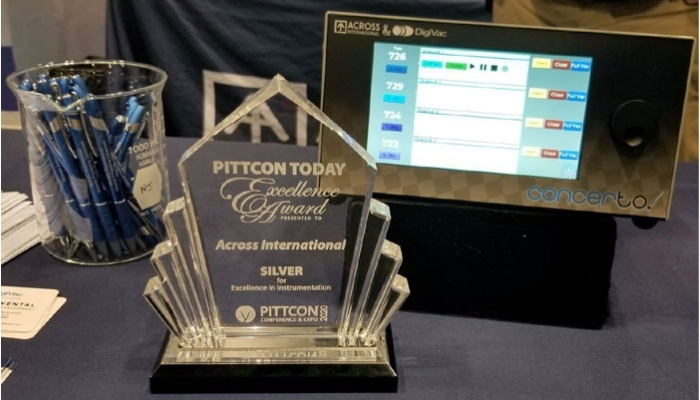
Across International won the PittCon 2020 Today’s Excellence Award in Innovation for the Concerto 4-Channel Vacuum & Pressure Controller, able to control four vacuum systems from a single controller and pump, and offers leading vacuum control technology to optimize performance of vacuum systems, reduce run times to achieve more effective drying and vacuum processing throughout industrial applications. Contact us to learn more about optimizing your operations.
In vacuum systems, measurement is everything. If you cannot trust the measurement, you cannot trust the diagnosis, research results, or production batch. Where accuracy is critical, trust in tools and partners that will ensure you deliver the results you need for success.
A Simple Best Practice That Pays for Itself
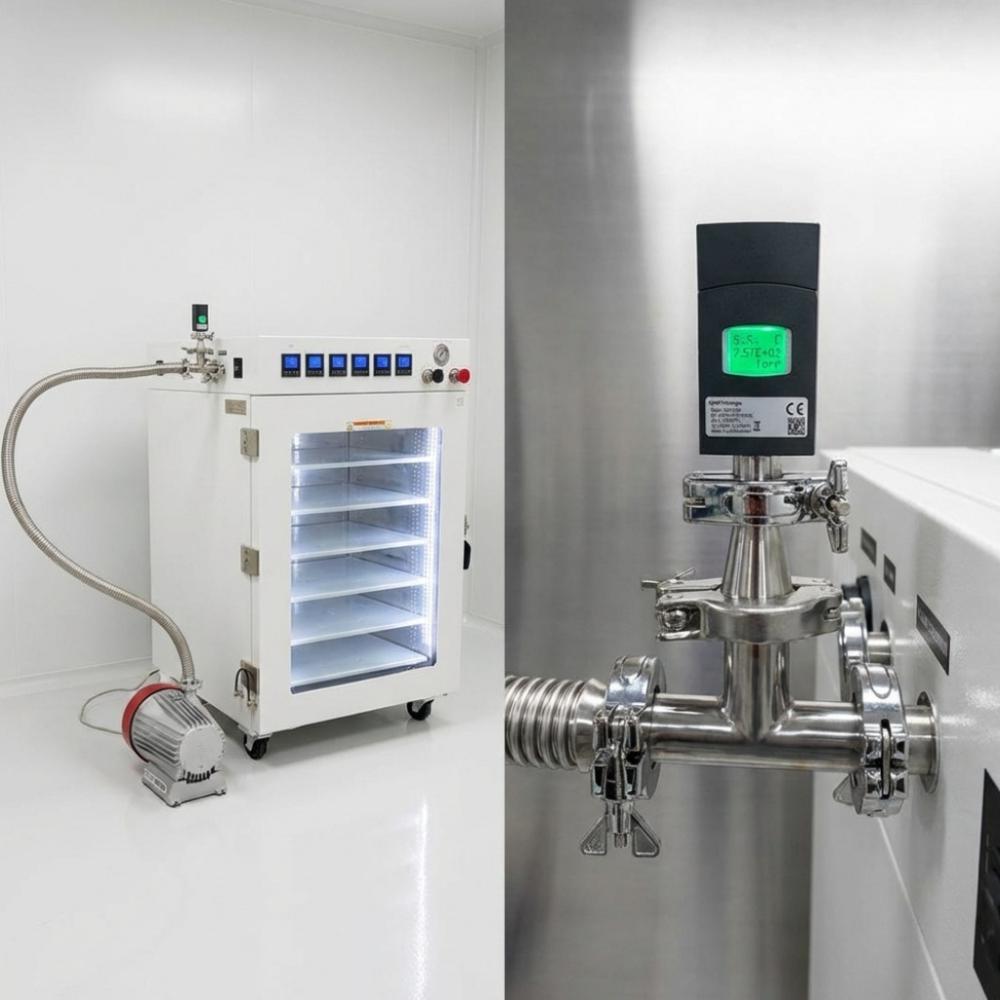
Every laboratory running vacuum equipment should have:
- At least one spare digital vacuum gauge
- Dedicated specifically for testing, verification, and troubleshooting
- Stored where technicians and operators can access it quickly
- A calibration schedule to ensure the gauge, and thus the lab, is performing
This one small investment can prevent:
- Unnecessary service calls
- Extended system downtime
- Misdiagnosed “leaks”
- Costly travel and lost productivity
- It also reduces your carbon footprint by eliminating avoidable site visits and emergency shipments.

Our Recommendation
FIRST, identify in what vacuum range your systems live.
Do you require a Pirani gauge for atmospheric pressure to single digit Torr / mBar?
A high vacuum gauge for sub-milliTorr readings, like a thermocouple temperature-based gauge, or diaphragm capacitance manometer mechanical gauge?
Or a combination of both for the full vacuum range?
You may find a brief buyer’s guide below overviewing each type of vacuum gauge technology, what vacuum ranges they cover, & please contact Across International now to purchase your digital vacuum gauge on hand, such as:
DigiVac Bullseye Precision Vacuum Gauge with Real-Time Analytics
DigiVac Bullseye Piezo Rough Vacuum Gauge with Isolated 775i Sensor
Agilent PCG-750 Pirani Capacitance Diaphragm High Vacuum Gauge
As part of our commitment to collaborating with you to improve laboratory uptime, diagnostics, and overall experience, Across International is offering special promotional pricing on select digital vacuum gauges!
Ready, Set, Optimize!
If you’d like to add a reliable digital vacuum gauge to your lab toolkit—or simply want advice on the right model for your system—contact us:
- [email protected]
- 888-988-0899
- www.acrossinternational.com
Because sometimes, for want of a gauge, far more is lost than necessary, and we’re here to help make sure that doesn’t happen again, to you or any laboratory colleague you send this piece of technical insight, and new discount gauge and calibration opportunity they will thank you for!
Buyer’s Guide: Vacuum Gauge Technologies From Most Shallow To Deepest Vacuum
1. Bourdon Tube / Mechanical Pressure Gauges
Range: Slight positive pressure above atmosphere → ~1 Torr / 1.33 mBar / 133 Pascal
Technology: Mechanical deformation
Typical use: Pressurized systems, rough monitoring, quick spot-checking, often included at no cost with your system
Key weakness:
- Not vacuum-optimized, impossible to adjust for barometric pressure and altitude
- Drift over time and not easy to calibrate
Often trusted. Even more frequently inaccurate and not the best tool for your application.
2. Diaphragm / Capacitance Manometers
Range: Atmosphere → ~10⁻⁴ Torr / mBar
Technology: Capacitance change from diaphragm deflection, essentially mechanical flexing of a membrane
Strengths:
- Gas-type independent
- High accuracy and repeatability
Key weakness:
- Expensive
- Sensitive to contamination and shock
- Sometimes limited to a specific range for accuracy, always check specifications of your gauge
Gold standard for calibration reference — must be NIST traceable, but make sure it covers the range you need.
3. Thermal Conductivity Gauges (Pirani / Thermocouple)
Range: ~760 Torr → ~10⁻³ Torr / mBar
Technology: Heat loss to surrounding gas
Typical use: Rough to medium vacuum
Key weakness:
- Gas-dependent readings, and can become inaccurate when dealing with VOCs and chemistries
- Drift due to filament aging
Most common gauge in labs, low cost, but higher energy consumption and can demand frequent calibration to ensure accuracy.
4. Convection-Enhanced Pirani Gauges
Range: ~1000 Torr → ~10⁻⁴ Torr / mBar
Technology: Thermal + convective heat transfer
Strengths:
- Wider range than standard Pirani
- Often integrated into digital controllers
Key weakness:
- Still gas-dependent, so calculations must be made for gas density to ensure true accuracy
- Accuracy degrades unnoticed
“Digital” does not mean “accurate.” Know what sensor technology is best for your work!
5. Cold Cathode Ionization Gauges (Penning / Inverted Magnetron)
Range: ~10⁻³ → ~10⁻⁹ Torr / mBar
Technology: Gas ionization via electrical discharge
Strengths:
- No hot filament
- Long operational life
Key weakness:
- Can fail to ignite at higher pressures
- Sensitive to contamination
Ideal for high vacuum systems with turbomolecular vacuum pumping alongside the standard rough pump.
6. Hot Cathode Ionization Gauges (Bayard-Alpert)
Range: ~10⁻⁶ → ~10⁻¹¹ Torr / mBar
Technology: Electron impact ionization
Typical use: High & ultra-high vacuum systems
Key weakness:
- Filament burnout
- Easily damaged by exposure to atmosphere
Must be handled with care, as improper handling can destroy accuracy long before failure is obvious. Calibration can avert these variables.
7. Spinning Rotor Gauges (SRG)
Range: ~10⁻⁷ → ~10⁻² Torr / mBar
Technology: Molecular drag on a magnetically levitated ball
Strengths:
- Extremely stable
- Primary transfer standard
Key weakness:
- Expensive
- Slow response, not industrially applicable
Often used as calibration reference, when traceability matters, but not applicable in an industrial setting.
Contact your account manager to take advantage of this promotion before it is over
If you’d like to add a reliable digital vacuum gauge to your lab toolkit—or simply want advice on the right model for your system—contact us:
- [email protected]
- 888-988-0899
- www.acrossinternational.com
Ensure a happily ever after your for project, each batch in your production and every report that delivers your hard-earned results, partner with Across International for accuracy in your plant and laboratory today!