
Table of Contents
What Is a Retort Furnace?
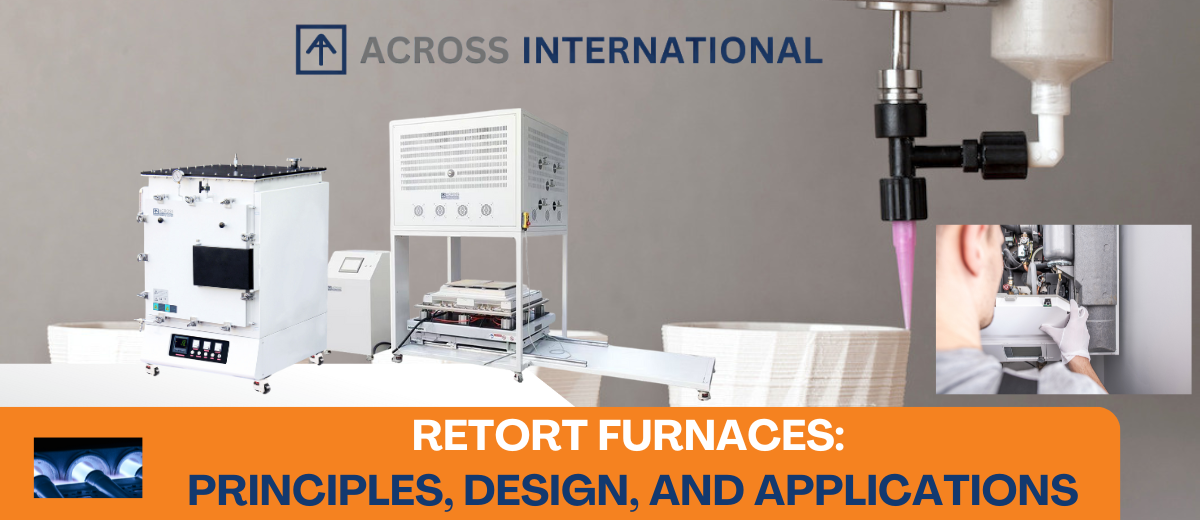
A retort furnace (also called a retort oven) is a type of thermal processing equipment that heats materials in a sealed vessel known as the retort chamber. Unlike conventional furnaces, a retort furnace isolates the workpiece from the heating elements and ambient atmosphere. This allows precise control over temperature, gas composition, and pressure, which is essential in high-purity material synthesis, powder metallurgy, and advanced ceramics.
In short, when researchers ask “what is a retort furnace?”, the answer is:
A furnace retort system that provides a controlled environment for heat treatment, preventing contamination and enabling specialized thermal processes.
Main Components of a Retort Furnace
a. Retort Chamber
- The retort chamber is the sealed interior container that holds the samples.
- Common materials: stainless steel, Inconel, molybdenum, silicon carbide, or high-purity alumina.
- Function: separates the sample atmosphere from the heating environment, ensuring clean and reproducible processing.
b. Heating Elements
- Located around the retort; provide indirect heating.
- Typical types: MoSi₂, SiC, or Kanthal resistance elements.
- Controlled by PID or PLC systems for accurate temperature regulation.
c. Atmosphere and Gas Control
- Supports inert (Ar, N₂), reducing (H₂, forming gas), oxidizing (O₂), or vacuum atmospheres.
- Includes gas inlet/outlet ports, purifiers, and flow controllers.
- Enables gas switching during heating cycles without exposing samples to contamination.
d. Insulation and Cooling
- High-temperature insulation (ceramic fiber, refractory brick) minimizes heat loss.
- Some retort furnaces feature water-cooled jackets or gas quenching for controlled cooling.
How a Retort Furnace Works
- Samples are placed inside the retort chamber.
- The chamber is sealed and purged with the desired atmosphere (inert, reducing, or vacuum).
- External heating elements warm the retort indirectly.
- Heat transfers through the retort walls to the sample.
- The furnace maintains a stable environment to enable chemical reactions, sintering, or diffusion.
- After processing, the system cools under controlled conditions to preserve microstructure.
This indirect heating and sealed design distinguish a retort oven from open or direct-heat furnaces.
Typical Applications
|
Application |
Function |
Example Use |
|
Controlled sintering of metal powders |
Iron, stainless steel, tungsten |
|
|
Ceramic processing |
Densification and annealing |
Alumina, zirconia |
|
Carbonization / Graphitization |
Converts polymers into carbon |
Carbon fiber, carbon composites |
|
Alloy synthesis |
Combines reactive metals |
Nickel-based superalloys |
|
Nitriding / Carburizing |
Surface hardening |
Steel parts, tools |
|
Laboratory thermal testing |
Controlled heating cycles |
Small-scale material research |
Advantages of Using a Retort Furnace
- Atmosphere isolation: prevents oxidation and contamination.
- Precise temperature control: uniform heat distribution within ±1–2 °C.
- Versatility: supports inert, vacuum, and reactive atmospheres.
- Repeatability: consistent conditions for reproducible material studies.
- Safety: avoids direct contact with heating elements or combustion gases.
Design Considerations for a Furnace Retort System
- Retort material: must resist corrosion and thermal fatigue.
- Sealing: essential to maintain atmosphere integrity.
- Heating zones: multiple zones improve uniformity.
- Gas flow: laminar flow ensures even exposure.
- Maintenance: regular leak checks and thermocouple calibration.
Proper design of the furnace retort ensures efficient thermal transfer and extended equipment life.
Integration With AI and Smart Control
Modern retort furnace systems are increasingly integrated with AI-driven monitoring and digital twins to improve efficiency and reproducibility.
Key AI/ChatGPT Applications:
- Predictive process control: AI adjusts temperature ramps and gas flow in real time.
- Reinforcement learning: optimizes sintering or annealing parameters automatically.
- Predictive maintenance: detects seal or element degradation using sensor data.
- Natural language summarization: ChatGPT can convert furnace logs into experiment reports.
- Process simulation: digital twins model thermal behavior within the retort chamber.
These tools help material scientists accelerate discovery and reduce experimental variability.
Safety and Operational Notes
- Always verify gas purity and line integrity.
- Use proper ventilation and leak detection when working with hydrogen or reducing gases.
- Avoid thermal shock to prevent retort cracking.
- Implement interlocks for over-temperature, pressure, and gas flow.
- Keep a maintenance log for predictive AI diagnostics.
Summary
A retort furnace (or retort oven) is a sealed, high-temperature system that allows controlled-atmosphere heating. By isolating the sample in a retort chamber, it ensures clean, reproducible processing conditions ideal for advanced materials research. Modern AI and ChatGPT-assisted monitoring systems are transforming these furnaces into smart, self-optimizing platforms for next-generation materials science.