
Today, every industry is moving towards energy-saving and clean ways of doing things. Therefore, the induction furnace has become popular because of its ability to conserve heat and energy without polluting the environment with gases and loud noises. Let us look at how the furnace works and understand how each component contributes to the process.
What Is Induction Melting?
Induction melting is the induction heating of a metal, typically within a crucible until the metal becomes molten using an induction furnace. Once the metal has fully melted, the liquid is then poured into an ingot mold or cast into a component at a foundry, or into smaller precise parts such as dental and jewelry castings.
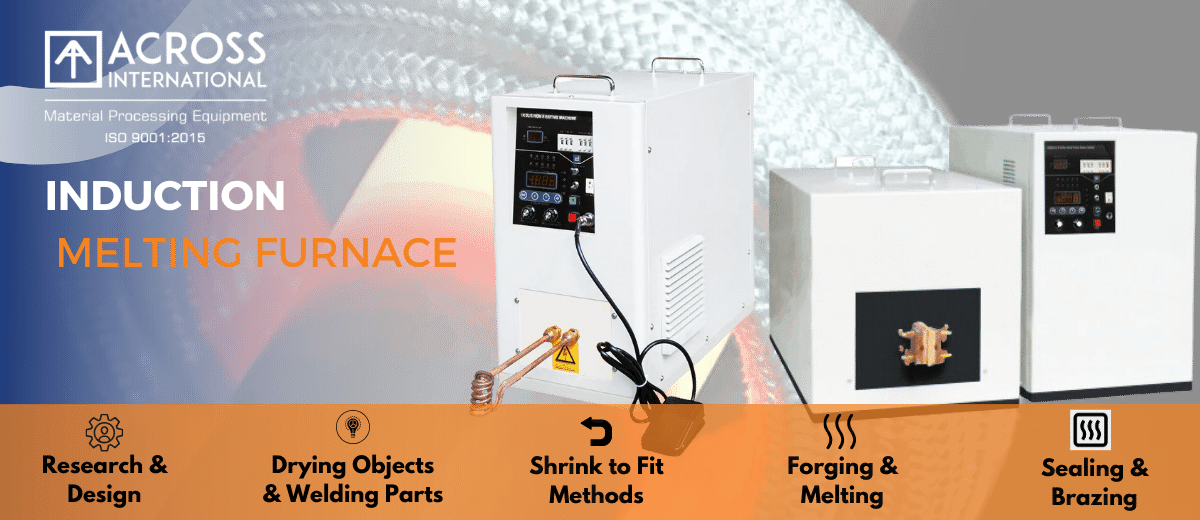
An induction melting furnace uses a copper induction heating coil that delivers an alternating magnetic current to the metal within the coil. This alternating magnetic current creates a resistance in the metal, causing it to heat and eventually to melt. Induction furnace technology does not require flames or gases that can be harmful to the environment to melt metals.
An induction furnace is therefore preferred in most modern foundries because it does not produce dust and other pollutants. The ability to melt the metals at regulated temperatures allowing them to retain their alloying elements, makes this furnace a better option.
How Does an Induction Melting Furnace Work?
There are four essential components in an induction melting furnace. The first one is the crucible, which is usually nonconductive and is used to hold the charge of the metal for melting. Next goes the yokes, which protect the copper coil from damage when it produces the magnetic field that induces the circular electric currents.
The water-cooled coil is the third component, made of copper wire and has a powerful alternating current flowing through it.
The best thing about this furnace is that heat originates from the furnace’s charge and is not an external heat source. That works well when you do not want to contaminate the metal you are melting. That characteristic puts the induction furnace ahead of any other heating process because there is very little heat lost.
The frequencies used in an induction furnace range between 50 to 400 kHz. However, it could go higher depending on the melting speed, type of material, and the volume of the furnace. If the volume of the melts is smaller, then the frequency of the furnace will be higher. Lower frequencies have higher penetration into the metal, referred to as skin depth.
Advantages of Using An Induction Melting Furnace
Less Heat Loss
Unlike traditional heating equipment, induction furnaces do not use heat conduction to heat the melt. It uses induction heating, which heats the metal and has thermal insulation materials to reduce heat loss. Therefore, an induction melting furnace offers less energy loss and higher thermal efficiency than other heating methods.
Produces High-quality Metals
This type of heating has no external heat sources because the heat comes from within the charge itself. Therefore, the chances of contamination are slim. Any metals melted in the furnace will be pure and high-quality. This benefit works best for most high-end products from metals like gold and silver.
The temperatures are also controlled, which keeps off excess heat and maintains the alloying elements of the metals. The induction furnace also uses electromagnetic force, which stirs the molten metal and ensures its uniform composition. Without the electromagnetic force, there would be no automatic mixing, and other forms of mixing may not be as effective or uniform as the automatic one.
Fast Speed of Melting
Melting in an induction furnace is fast because of the controlled temperatures and the high thermal efficiency. It is an excellent way to melt high volumes of metal as each melting session will take a considerably short time. You can maximize production and still retain the high quality of the metals you melt. This melting process is good for both ferrous and non-ferrous metals.
Less Environmental Pollution
The impact of induction melting furnace on the environment is small because it only produces a small noise. It is also a clean melting process, meaning no dust or gases are made. These aspects make it favorable for any environment and working space.
When you compare it to other melting methods, it has the least environmental impact and is, therefore, safe to use. Employees using the furnace will be able to work in a safe environment that has little to no dust or other gas emissions. This furnace allows you to do your job without endangering your life or the environment.
Cost-effective Way of Melting Metals
Now that this process melts metals fast and does not produce unnecessary high temperatures, the furnace life extends, giving you value for money. It saves you maintenance costs, which makes it relatively cost-effective.
This furnace uses no electrodes or fuel, making it easy and affordable. It also takes up less space because of its compact design.
Easy to Automate Operations
You can achieve higher production volumes without affecting the quality when you automate your induction heating process. The design of the machine makes it easy to integrate communication between the material handling and the heating process.
Conclusion
An induction melting furnace is efficient in melting most metals. Its versatility and efficiency make it the most preferable in today’s foundries. It is also energy-saving, making it a much better option than other traditional melting processes.