



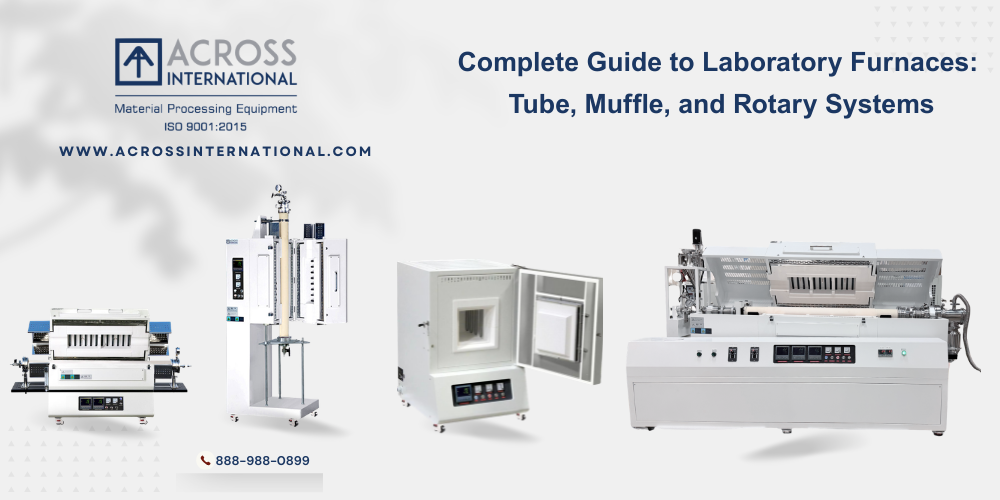
Choosing Laboratory Furnaces: Tube, Muffle & Rotary
Precision thermal processing plays an important role in materials science, energy storage, aerospace research, ceramics, metallurgy, and advanced manufacturing. The right laboratory furnace directly affects temperature control, atmosphere stability, sample quality, and process repeatability.
The main difference between laboratory furnace types is not only maximum temperature. It is also important to understand how the sample needs to be processed: in air, under controlled atmosphere, under vacuum, as a static batch, or in continuous motion.
This guide compares muffle, tube, rotary and tilting furnaces, and specialized crystal growth furnaces. It will help you understand which type of laboratory furnace is better suited for different materials, processes, and research applications.
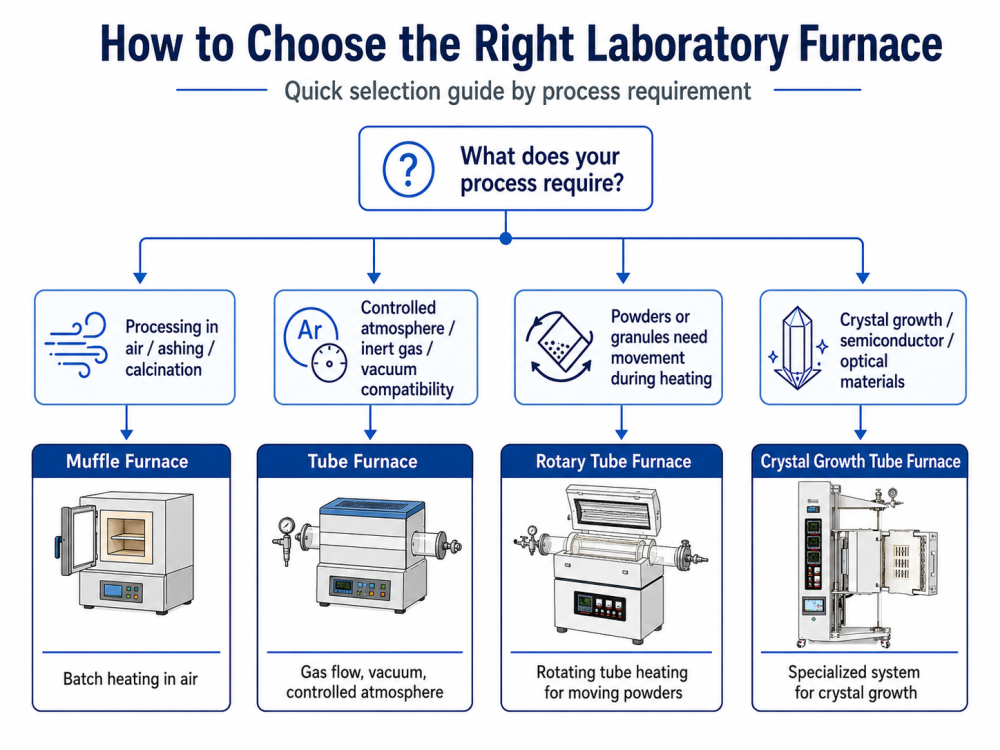
Table of Contents
- Muffle Furnaces: High-Temperature Batch Processing
- Tube Furnaces: Precision Heating and Controlled Atmospheres
- Rotary and Tilting Furnaces: Processing Powders and Granular Materials
- Specialized Systems: Crystal Growth Furnaces
- Quick Comparison: Muffle vs. Tube vs. Rotary Furnaces
- How to Choose the Right Laboratory Furnace
- Laboratory Furnaces from Across International
Muffle Furnaces: High-Temperature Batch Processing
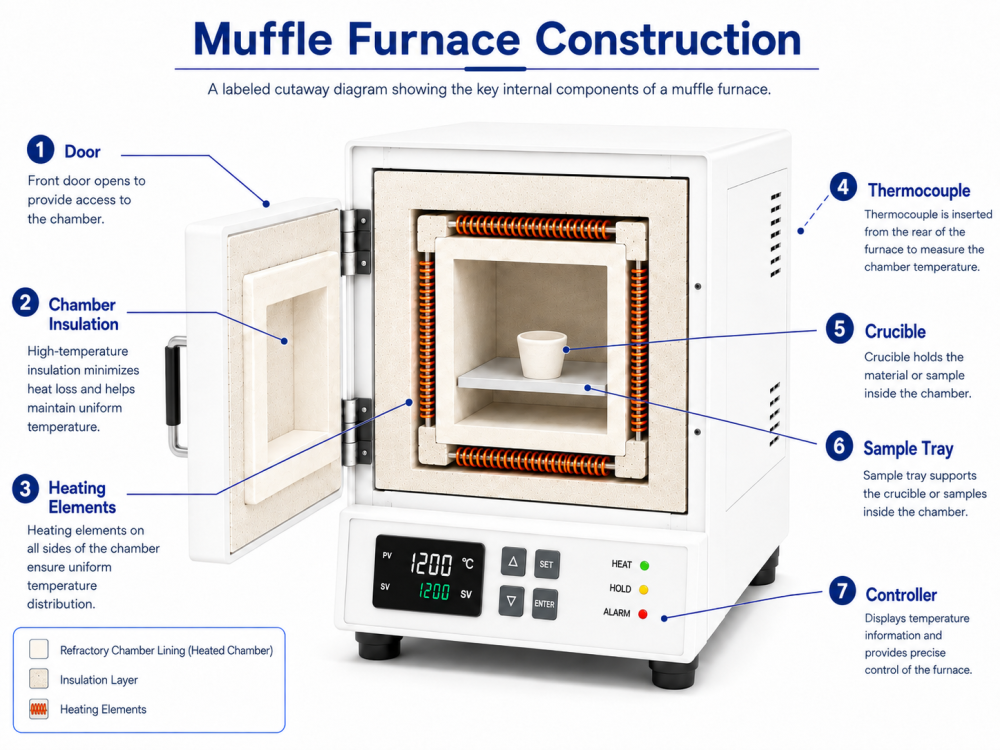
Muffle furnaces are widely used for high-temperature batch processing in laboratories and industrial testing environments. These front-loading chamber furnaces heat materials inside an insulated chamber while keeping samples separated from direct contact with the heating elements.
Because of their chamber-style design, muffle furnaces are practical for processing crucibles, trays, small parts, ceramic samples, powders, and other batch materials. They are often used when the process can be performed in ambient air and does not require strict atmosphere control.
Across International muffle furnaces are available in different temperature ranges and configurations depending on the application requirements.
Ideal Applications
Muffle furnaces are commonly used for:
- Ashing, ignition, and combustion testing
- Loss on ignition (LOI) testing
- Ceramic firing and curing
- Glass fusing and enamel processing
- Heat treatment of small samples and components
- Dental and zirconia thermal processing
- Material calcination and thermal decomposition
- Sample preparation for laboratory analysis
- Annealing and controlled heating applications
- Burn-off of organic materials and binders
Tradeoffs and Limitations
Standard muffle furnaces typically operate in ambient air. This makes them a good choice for oxidation-tolerant materials, but not the best option for oxygen-sensitive metals or processes that require inert gas, reducing atmosphere, or vacuum conditions.
If the material may oxidize, discolor, or react with air at high temperatures, a tube furnace, vacuum furnace, or controlled atmosphere furnace may be more suitable.
For applications that require a chamber furnace for ashing, calcination, ceramics, or general heat treatment, consider Across International Muffle Furnaces.
Tube Furnaces: Precision Heating and Controlled Atmospheres
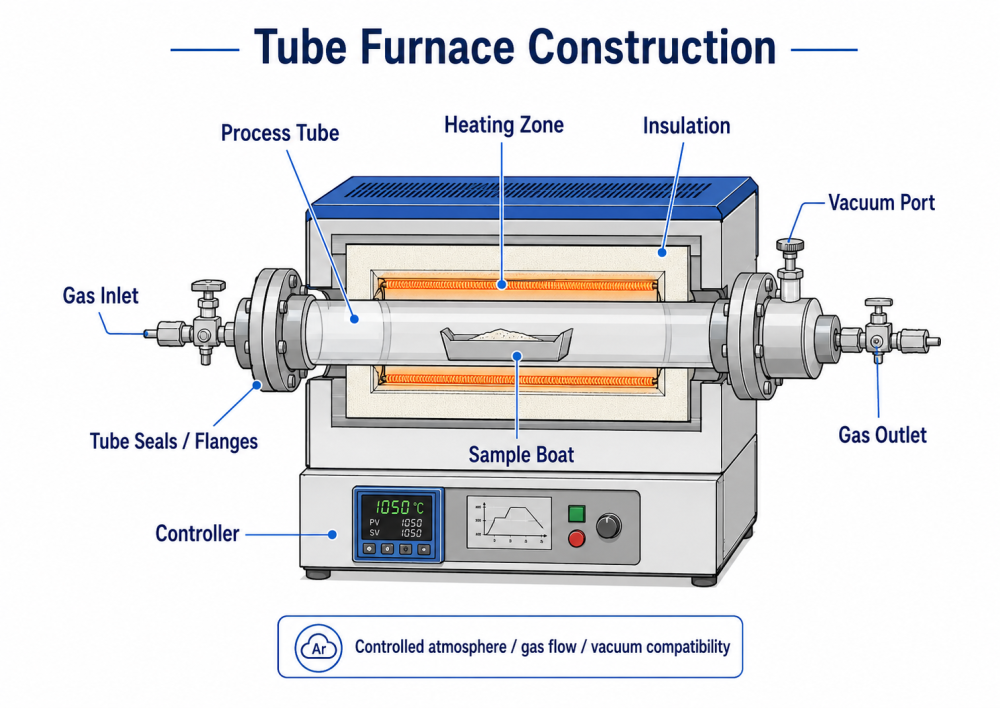
Tube furnaces are designed for applications that require controlled atmosphere, gas flow, vacuum compatibility, or uniform heating along a tube. Instead of placing the sample inside an open chamber, the material is processed inside a ceramic, quartz, or other process tube.
This design allows users to purge the tube with inert gas, introduce process gases, or operate under vacuum depending on the furnace configuration. Tube furnaces are often used in research and production environments where oxygen exposure, contamination, or gas composition can affect final material properties.
Across International offers horizontal, vertical, single-zone, and multi-zone tube furnace systems. Multi-zone models can help create more uniform hot zones or controlled temperature gradients for advanced research applications.
Ideal Applications
Tube furnaces are commonly used for:
- Materials research and advanced synthesis
- Annealing, tempering, and purification
- Controlled atmosphere processing
- CVD and thin-film processes
- Powder and small-sample heat treatment
- Oxygen-sensitive material processing
- Semiconductor and battery material research
- Calcination and thermal decomposition
- Sintering and ceramic processing
- Gas-solid reaction studies
- Catalyst development and testing
- Nanomaterial synthesis
- Carbonization and pyrolysis
- Heat treatment under vacuum or inert gas
- Research requiring precise temperature and atmosphere control
Tradeoffs and Limitations
Tube furnaces provide stronger atmosphere control than standard muffle furnaces, but they also require more careful setup and maintenance. Users need to consider tube material, seals, gas flow, vacuum connections, and pump compatibility.
They also have smaller sample capacity because the usable space is limited by tube diameter and hot zone length. For larger batch samples, a muffle furnace may be more practical.
If your process requires inert atmosphere, gas flow, or vacuum compatibility, consider Across International Horizontal Tube Furnaces or other tube furnace systems based on your process requirements.
Rotary and Tilting Furnaces: Processing Powders and Granular Materials
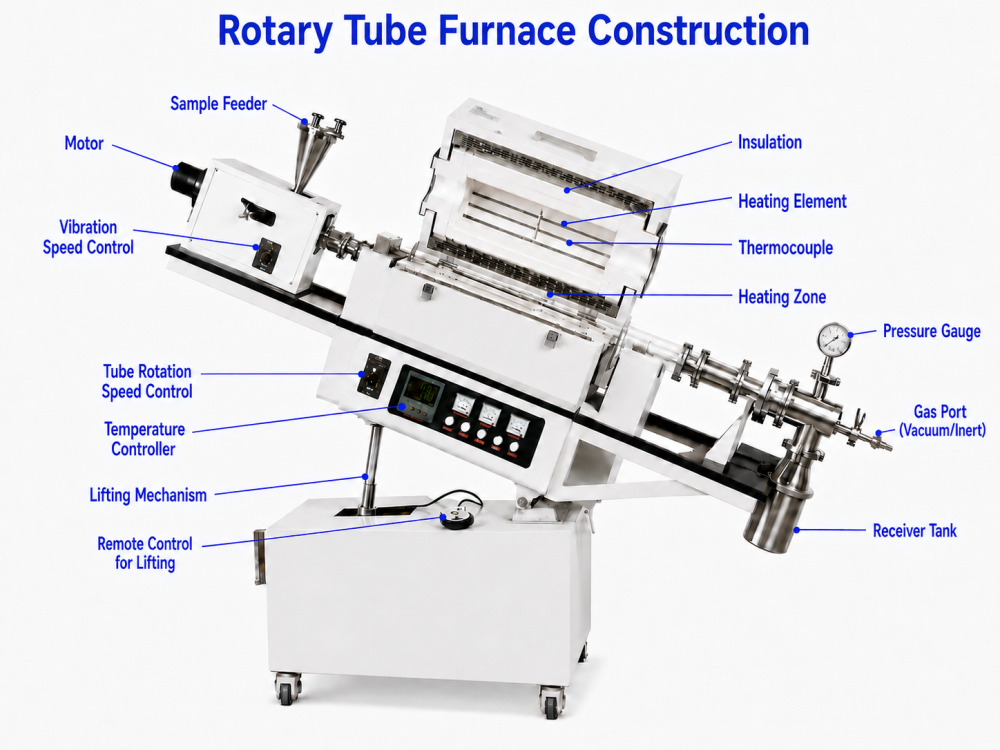
Rotary and tilting furnaces are designed for applications where powders, granules, or particles need to be heated while in motion. Instead of keeping the sample static, these systems rotate or tilt the material during processing.
This format is especially useful when the goal is not only to heat the material, but also to expose particles more evenly to heat and the process atmosphere. This can be important for calcination, oxidation, reduction, coating, battery material processing, and other processes where results depend on uniform treatment of the full material load, not only the outer layer.
Material movement helps reduce the risk of local overheating, uneven thermal exposure, and particle agglomeration compared with static batch processing.
Ideal Applications
Rotary and tilting furnaces are commonly used for:
- Powder calcination
- Oxidation and reduction processes
- Battery cathode and anode material research
- Catalyst processing
- Continuous or semi-continuous powder treatment
- Coating and thermal processing of granular materials
- Uniform heating and mixing of powders
- Sintering and thermal treatment of particulate materials
- Carbonization and pyrolysis
- Drying and moisture removal from powders
- Chemical reaction processing under controlled atmospheres
- Pilot-scale material processing and process development
Tradeoffs and Limitations
Because rotary and tilting furnaces include moving parts, they may require more mechanical maintenance than static muffle or tube furnace systems. In practice, this means users should periodically check the drive mechanism, rollers, seals, bearings, connections, tilt system, rotating tube, and other components exposed to regular motion and wear.
It is also important to consider material loading, rotation speed, tilt angle, tube material, atmosphere requirements, and cleaning needs after powder processing.
For simple static samples, a muffle or tube furnace may be easier to operate. For powders, granules, and bulk material processing, rotary or tilting systems are often a better fit.
Across International offers Rotary & Tilting Furnaces for high-temperature processing of powders, granular materials, and research applications. The team can help select a configuration based on temperature, atmosphere, material type, load volume, and uniformity requirements.
Specialized Systems: Crystal Growth Furnaces
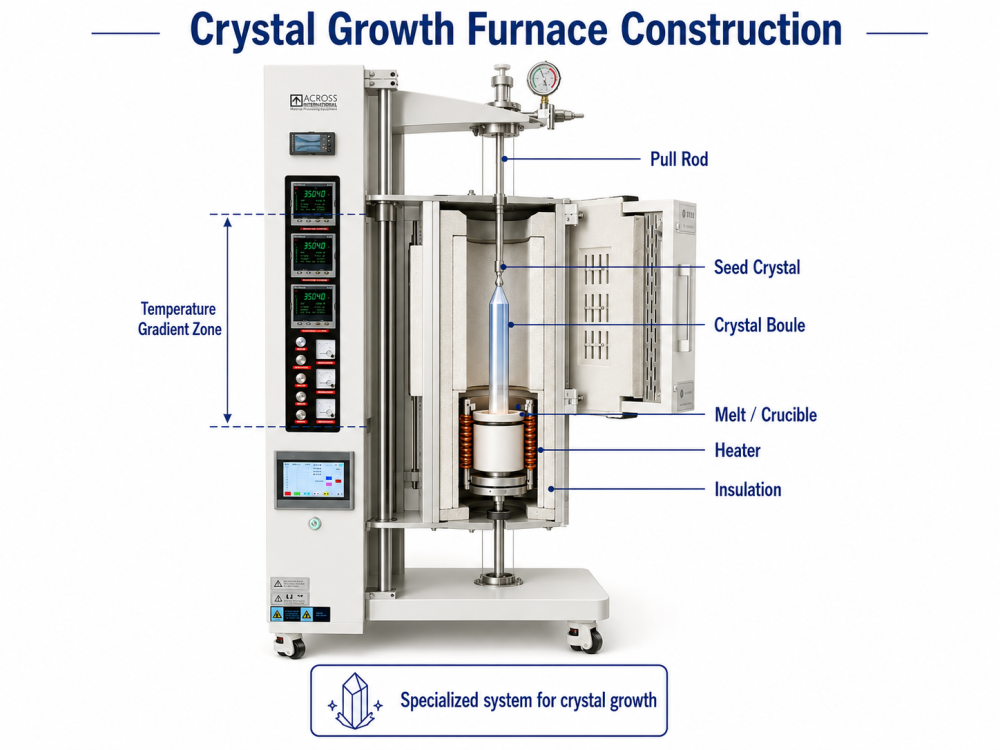
High-quality crystal growth requires more than simply heating a material to a high temperature. These processes require precise control of temperature gradients, movement rate, melt stability, seed crystal position, and solidification conditions. For this reason, semiconductor, optical, and advanced material applications use specialized crystal growth furnaces.
Two common crystal growth methods are Bridgman and Czochralski. The Bridgman method typically relies on controlled directional solidification, while the Czochralski method involves melting feed material and slowly pulling a seed crystal from the melt to form a single crystal ingot.
Ideal Applications
Crystal growth furnaces may be used for:
- Semiconductor crystal growth
- Sapphire and optical material production
- Germanium, silicon, and gallium arsenide research
- Crystalline metal and salt growth
- Advanced materials development
- Single-crystal growth and solidification studies
- High-purity crystal preparation
- Research on crystal structure and material properties
- Optoelectronic material development
- Controlled cooling and directional solidification
- Academic and industrial crystal growth research
- Development of electronic and photonic materials
Tradeoffs and Limitations
Crystal growth systems are more specialized than standard laboratory furnaces. They usually require tighter thermal control, stable movement, careful process setup, and higher investment.
Even small temperature deviations, unstable temperature gradients, vibration, or changes in pulling speed can lead to defects in the crystal structure. This can affect crystal uniformity, create internal stress, cause dislocations or cracks, and reduce the electrical or optical performance of the material.
For semiconductor crystal growth, sapphire, optical materials, or specialized research applications, Across International offers Crystal Growth Furnaces and can help select a system based on growth method, temperature range, and process stability requirements.
Quick Comparison: Muffle vs. Tube vs. Rotary Furnaces
|
Furnace Type |
Best For |
Atmosphere Control |
Sample Type |
Main Limitation |
|
Muffle Furnace |
Ashing, calcination, ceramics, general heat treatment |
Limited; typically ambient air |
Batch samples, crucibles, trays, small parts |
Not ideal for oxygen-sensitive materials |
|
Tube Furnace |
Controlled atmosphere processing, CVD, annealing, materials research |
Strong, depending on configuration |
Powders, rods, substrates, small samples |
Limited by tube diameter and hot zone length |
|
Rotary / Tilting Furnace |
Powder processing, calcination, battery materials, granular samples |
Available depending on system design |
Powders, particles, granular materials |
Requires checks of moving components and more mechanical maintenance |
|
Crystal Growth Furnace |
Semiconductor, optical, and advanced crystal growth |
Highly specialized |
Crystal growth materials |
Higher cost and process complexity |
How to Choose the Right Laboratory Furnace for Your Application
Choosing the right laboratory furnace depends on the material, temperature range, atmosphere requirements, sample format, process goals, and documentation needs. The criteria below can help narrow the choice.
Temperature Range and Heating Precision
The first step is to define the working temperature and the required heating stability.
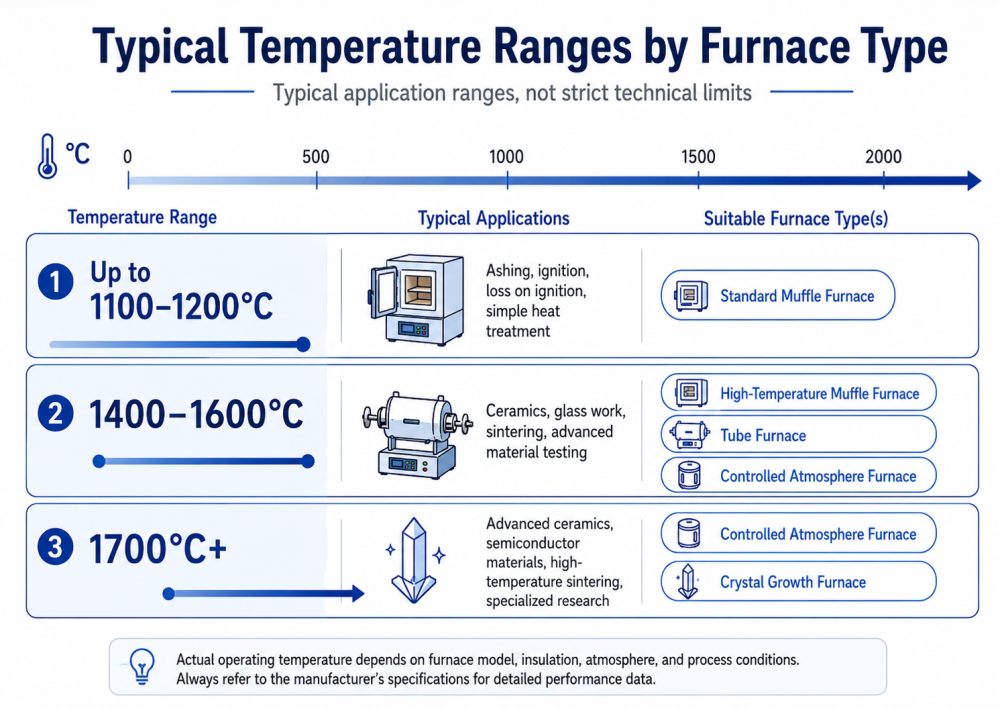
For basic laboratory tasks, ashing, drying, ignition, loss on ignition, and simple heat treatment, a range up to 1100–1200°C is often sufficient. Standard muffle furnaces are commonly used for these applications.
For ceramics, glass work, some sintering processes, and advanced material testing, temperatures in the 1400–1600°C range may be required. In this range, the right choice depends on the material, required uniformity, and atmosphere needs. High-temperature muffle furnaces, tube furnaces, or controlled atmosphere systems may be suitable.
For more demanding processes, including advanced ceramics, semiconductor materials, high-temperature sintering, and specialized research, 1700°C or higher may be required. In these cases, users should evaluate not only maximum temperature, but also heating elements, insulation, chamber design, controller accuracy, and temperature uniformity.
For example, if ceramic samples need to be processed in air, a high-temperature muffle furnace may be suitable. If the same material needs to be processed in inert atmosphere or under controlled gas flow, a tube furnace or controlled atmosphere furnace may be a better choice.
Atmosphere and Oxidation Risk
The next key factor is the environment in which the process must take place.
If the material is stable in air and the process involves oxidation, ashing, or calcination, a muffle furnace is often the simplest and most practical option.
If the material is oxygen-sensitive, may oxidize, change composition, become contaminated, or lose properties when exposed to air, the process requires stronger atmosphere control. In this case, a tube furnace, vacuum furnace, or controlled atmosphere furnace should be considered.
For example, standard ashing of an organic sample is usually well suited to a muffle furnace. Heat treatment of an oxygen-sensitive metal or synthesis of materials under inert atmosphere is usually better suited to a tube furnace with gas flow or vacuum compatibility.
Sample Size and Loading Format
Sample size and shape directly affect furnace selection.
Muffle furnaces are practical for batch samples, crucibles, trays, ceramic pieces, small parts, and irregularly shaped samples. The chamber design makes loading easier and allows multiple samples to be processed at the same time.
Tube furnaces are better suited for smaller samples, powders in boats, rods, wires, substrates, and processes that require controlled atmosphere. Their limitation is tube diameter and hot zone length.
Rotary and tilting furnaces are better suited for powders, granules, and materials that need movement during heating. This is important when the goal is to improve particle-level uniformity, reduce clumping, or improve contact between the material and the gas environment.
Process Type
Different furnace types are better suited for different processes.
For ashing, ignition, loss on ignition, calcination in air, and general heat treatment, muffle furnaces are often used.
For CVD, annealing, controlled atmosphere processing, purification, and oxygen-sensitive materials, tube furnaces are often more suitable.
For powder calcination, catalyst processing, battery material research, and continuous powder treatment, rotary or tilting systems are often more useful.
For semiconductor crystal growth, sapphire, and optical materials, specialized crystal growth furnaces are required.
Compliance, Safety, and Documentation
Some industries require additional documentation, safety features, or compliance with specific processing standards. Aerospace, defense, pharmaceutical, and advanced manufacturing applications may require stricter process control, calibration, data logging, and documentation.
If the process involves volatile materials, flammable gases, hydrogen, aggressive vapors, or hazardous chemicals, the furnace configuration should be reviewed from a safety standpoint. This may include gas safety systems, exhaust, interlocks, monitoring, ventilation, and compatibility review.
Controller Technology and Data Logging
Modern furnace applications often require programmable temperature profiles, ramp and dwell steps, alarm systems, and data logging. A programmable controller helps improve process repeatability and provides better documentation for research, production, or quality control workflows.
For simple tasks, a basic controller setup may be sufficient. For more complex processes, it is better to choose a system with a programmable controller, multiple heating zones, recipe storage, alarms, and data logging.
Laboratory Furnaces from Across International
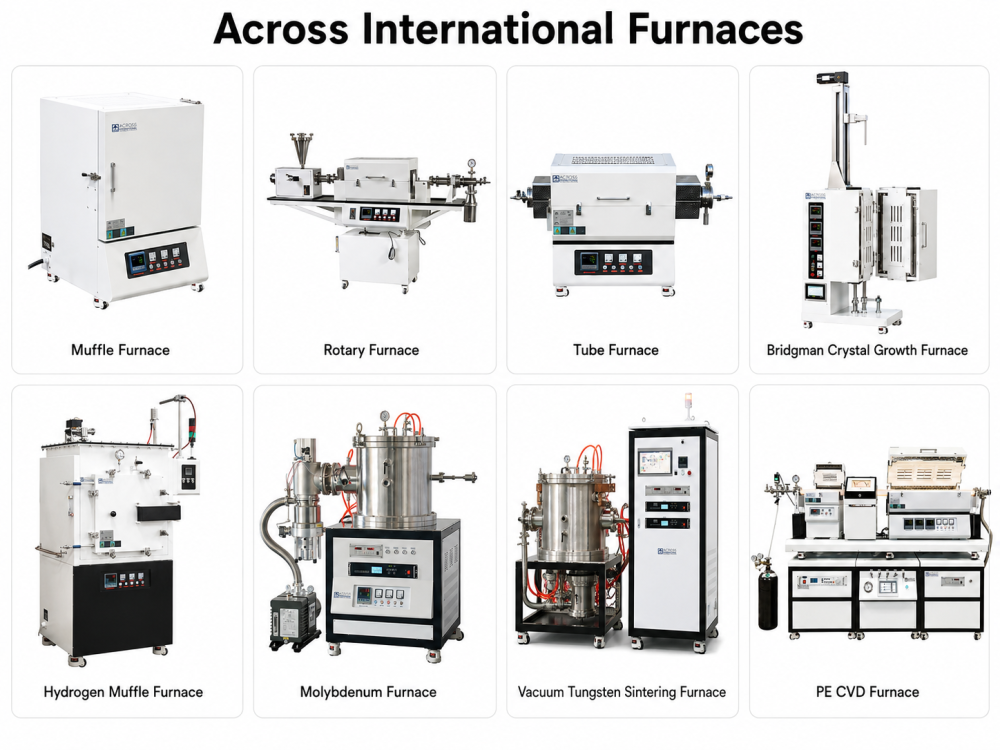
Across International offers a wide range of laboratory furnaces for research, testing, and industrial applications, including muffle furnaces, tube furnaces, rotary and tilting furnaces, controlled atmosphere furnaces, vacuum furnaces, and crystal growth furnaces.
The right furnace depends on the material, target temperature, atmosphere requirements, sample size, and process goals. Across International can help evaluate these requirements and recommend a furnace configuration for the application.
Contact Across International to discuss laboratory furnace options for high-temperature processing, materials research, controlled atmosphere applications, and custom furnace requirements.
Frequently Asked Questions
What type of laboratory furnace is best for ashing?
A muffle furnace is typically the best choice for ashing applications. Its chamber design is well suited for crucibles, trays, and batch samples processed in air. Muffle furnaces are commonly used for ashing, loss-on-ignition testing, combustion, and other processes where organic material needs to be removed at high temperatures.
Can a laboratory furnace operate under vacuum?
Yes, but the furnace must be designed or configured for vacuum operation. Tube furnaces are often used for vacuum-compatible processing because the process tube can be sealed and connected to a vacuum system. Dedicated vacuum furnaces are another option for applications that require low-pressure environments, reduced oxidation, or controlled heat treatment.
What is the difference between a tube furnace and a muffle furnace?
A tube furnace heats samples inside a cylindrical process tube and is better suited for controlled atmospheres, gas flow, vacuum-compatible processing, and oxygen-sensitive materials. A muffle furnace uses an enclosed chamber and is generally more practical for larger batch samples, simple loading, and high-temperature processing in air.
For a more detailed comparison, see our Tube Furnace vs Muffle Furnace: Which Is Right for Your Lab? guide.
What temperature range should I choose for a laboratory furnace?
The required temperature range depends on the material and process. Applications such as ashing, ignition, and general heat treatment often require temperatures up to approximately 1100-1200°C. Ceramics, sintering, glass processing, and advanced materials research may require 1400-1700°C or higher. It is important to choose a furnace based on the required working temperature, rather than simply selecting the model with the highest maximum temperature.