
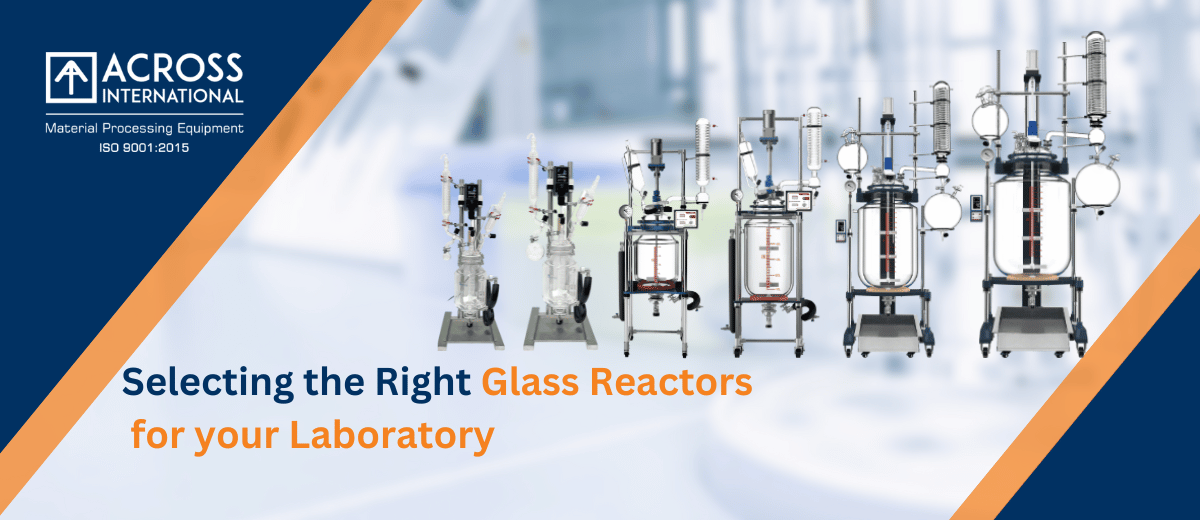
Glass reactors are versatile and widely used in a variety of laboratory applications. They offer several advantages over other types of reactors, such as:
Transparency: Glass reactors allow for visual observation of reactions, which can be helpful in monitoring progress and identifying problems.
Chemical inertness: Glass is non-reactive with most chemicals, making it a good choice for a wide range of reactions.
Easy to clean: Glass reactors are relatively easy to clean, which is important for preventing contamination.
When selecting a glass reactor for your laboratory, there are following factors to consider:
Volume: Glass reactors are available in a variety of volumes, from a few milliliters to several liters. The volume of the reactor you need will depend on the scale of your reactions.
Type of jacket: Glass reactors can have single or double jackets. A single jacket allows for heating or cooling, while a double jacket allows for more precise temperature control.
Agitation: Most glass reactors have a stirrer to ensure proper mixing of reactants. The type of stirrer you need will depend on the viscosity of the materials you are working with.
Accessories: A variety of accessories are available for glass reactors, such as condensers, reflux dividers, and distillation heads. The accessories you need will depend on the specific reactions you are performing.
Common types of glass reactors
Single Jacketed glass reactors: These reactors are the simplest and most affordable type of glass reactor. They are typically used for reactions that do not require precise temperature control.
Singlewalled glass reactor
Double Jacketed glass reactors: These reactors have a jacket that surrounds the reaction vessel. The jacket can be used to circulate heating or cooling fluid, allowing for more precise temperature control.
Multi-neck glass reactors: These reactors have multiple necks that can be used to add reagents, remove products, or attach accessories. They are a good choice for reactions that require multiple steps or the addition of multiple reagents.
Small glass reactors: These reactors are designed for small-scale reactions. They are a good choice for screening reactions or for developing new processes.
There are various benefits to using Chemical Glass reactors. From flexibility to cost efficiency, glass-lined reactors provide convenience and value to your set of chemistry lab equipment
High resistance
Glass-lined reactors offer excellent corrosion resistance. They can withstand various concentrations of inorganic acid, organic acid, and organic solvents. Glass-line reactors are the best choice if you frequently process highly acidic substances. By contrast, traditional steel-lined reactors cannot provide the same resistance because they're very corrosive.
Versatility
Glass-lined reactors are reliable in terms of their flexibility. They can tolerate most chemicals and lab operations. As such, you can use the same reactor to process different substances. Just make sure to clean it between batches.
Heat Resistance
Since glass is transparent, you can easily see the chemicals and substances being processed. Inspection is more convenient, which means error detection can be done efficiently.You can also observe other vital parts of chemical operations. A clean-in-place (CIP) process is more straightforward because you can see through the glass. For example, you can easily see if there are any mixing issues, if the solids clump, and if other process complications are present.
Excellent visibility
Vessels in glass reactors can weather high temperatures and pressures. Steel vessels provide higher heat transfer rates, while glass vessels are best for chemistry applications with intense heat. If you're processing temperature-sensitive substances, opt for a dual-jacketed glass reactor that offers more accurate temperature control.
Cost efficiency
Glass reactors may appear costly as they are more expensive than steel-lined reactors. However, they are a practical investment since their versatility allows you to use them with almost all substances. There is no need to purchase another reactor in a different material because they can handle most bases and acids.
Ultimately, the advantages you gain from a glass-lined reactor are worth the investment since it makes your lab work easier and faster.
Use of Glass Reactors in different applications
Chemical synthesis: Glass reactors are commonly used for a wide range of chemical synthesis reactions, such as the production of organic compounds, inorganic salts, and pharmaceutical raw materials.
Crystallization: Glass reactors are also used for crystallization processes, where a solute is dissolved in a solvent and then allowed to crystallize out of solution. This is a common method for purifying chemicals.
Distillation: Glass reactors can be used for distillation, which is a process of separating a mixture of liquids based on their boiling points.
Extraction: Glass reactors can be used for extraction, which is a process of separating a desired compound from a mixture. This is often done using a solvent that will dissolve the desired compound but not the other components of the mixture.
Bioreactor: Glass reactors can be used as bioreactors, which are vessels used to grow cells or microorganisms. This is a common method for producing enzymes, vaccines, and other biological products.
Glass reactors are a versatile and valuable tool for any laboratory. By selecting the right reactor for your needs, you can ensure that you are able to perform your experiments safely and efficiently.