
Planetary ball mills are well known and used for particle size reduction on laboratory and pilot scales for decades while during the last few years the application of planetary ball mills has extended to mechanochemical approaches. Processes inside planetary ball mills are complex and strongly depend on the processed material and synthesis and, thus, the optimum milling conditions must be assessed for each individual system.
The present review focuses on the insight into several parameters like properties of grinding balls, the filling ratio or revolution speed. It gives examples of the aspects of grinding and illustrates some general guidelines to follow for modelling processes in planetary ball mills in terms of refinement, synthesis' yield and contamination from wear.
The amount of energy transferred from the milling tools to the powder is significant and hardly measurable for processes in planetary ball mills. Thus numerical simulations based on a discrete-element-method are used to describe the energy transfer to give an adequate description of the process by correlation with experiments. The simulations illustrate the effect of the geometry of planetary ball mills on the energy entry. In addition the imaging of motion patterns inside a planetary ball mill from simulations
Planetary Ball Mill Operation
Planetary Ball Mills enable the convenient programming of the following grinding parameters:
* Grinding duration in hours and minutes
* Speed ratio (speed sun wheel : grinding jar)
Features and benefits
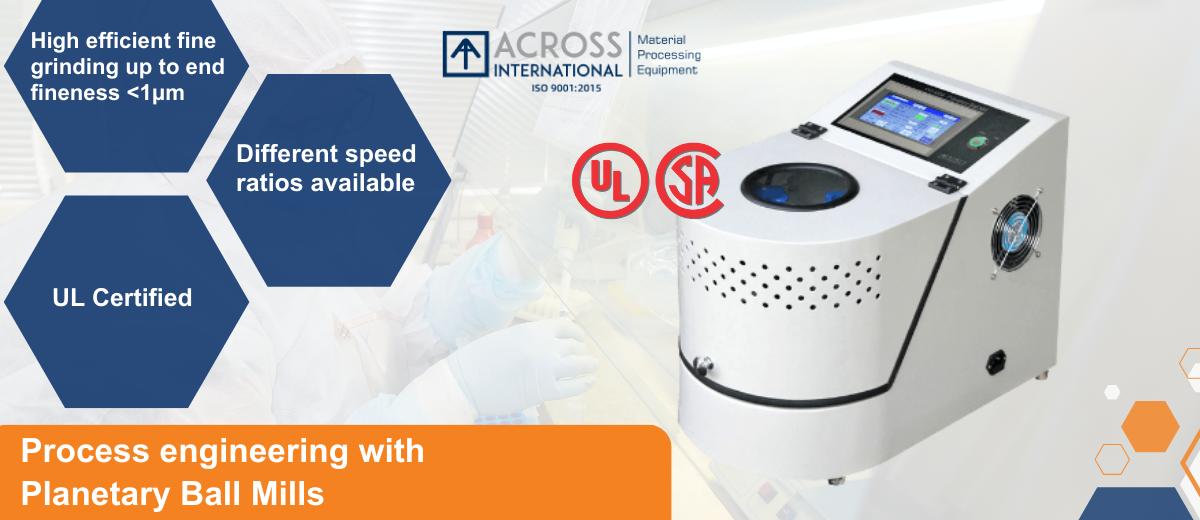
* High efficient fine grinding up to end fineness <1µm
* Different speed ratios available
* Grinding jars from 125ml to 500 ml in different materials
* Suitable for long-term trials and continuous use
* Automatic direction reversal to avoid agglomerations
* Reproducible results due to progr. grinding parameters
* UL/CSA – certified
Grinding jars
The selection of the right grinding jar and the correct filling level has a big impact on the grinding result. According to the application you must select the correct material and amount/volume for the grinding jar and the grinding balls.
A jar filling should consist of about 1/3 sample and 1/3 ball charge. The remaining third is the free jar volume that is necessary for the movement of the balls. The following table provides recommendations.
Planetary ball mill is a very often used machine for mechanical alloying, especially in Europe. Because very small amount of powder (for example, as little as a few grammes), is required, the machine is suitable for research purposes in the laboratory. A typical planetary ball mill consists of one turn disc (sometimes called turn table) and two or four bowls. The turn disc rotates in one direction while the bowls rotate in the opposite direction. The centrifugal forces created by the rotation of the Mechanical Alloying.
Request Complimentary Lab Testing Service:
We will design and test the optimal Ball Mill griding solution for your application .You need to buy grinding Jars for the testing . Request for Lab Testing.
Contact Across International for Your Ball Mills Today for further details.