
What is forging?
Forging is a process where a metal shaping technique using compressive, localized forces, has been a staple metal fabrication technique since the time of the ancient Mesopotamians. Since its origins in the fertile crescent, forging has experienced significant changes, resulting in a more efficient, faster, and more durable process. This is because today, forging is most performed with the use of forging presses or hammering tools that are powered by electricity, hydraulics, or compressed air. Some of the common materials used for forging are carbon steel, alloy steel, micro alloy steel, stainless steel, aluminum, and titanium
It is one of the oldest known metalworking processes. Metals can be forged cold, warm, or hot. Cold forging is used for forming softer materials and smaller steel parts, but this process hardens the material making it brittle and difficult to process after forging. Hot forging is when a part is heated above the material recrystallization temperature before forging, typically 1100 °C (2012 °F). Hot forging allows a part to be formed with less pressure, creating finished parts with reduced residual stress that are easier to machine or heat treat. Warm forging is forging a part below the recrystallization temperature, typically below 700 °C (1292 °F).
Some processes require a whole part to be forged, called billet heating, such as manufacturing automobile crankshafts. In other applications, only one end of a part needs to be forged, called bar end heating, such as manufacturing automobile steering components or hot heading fasteners.
Why Induction Heating?
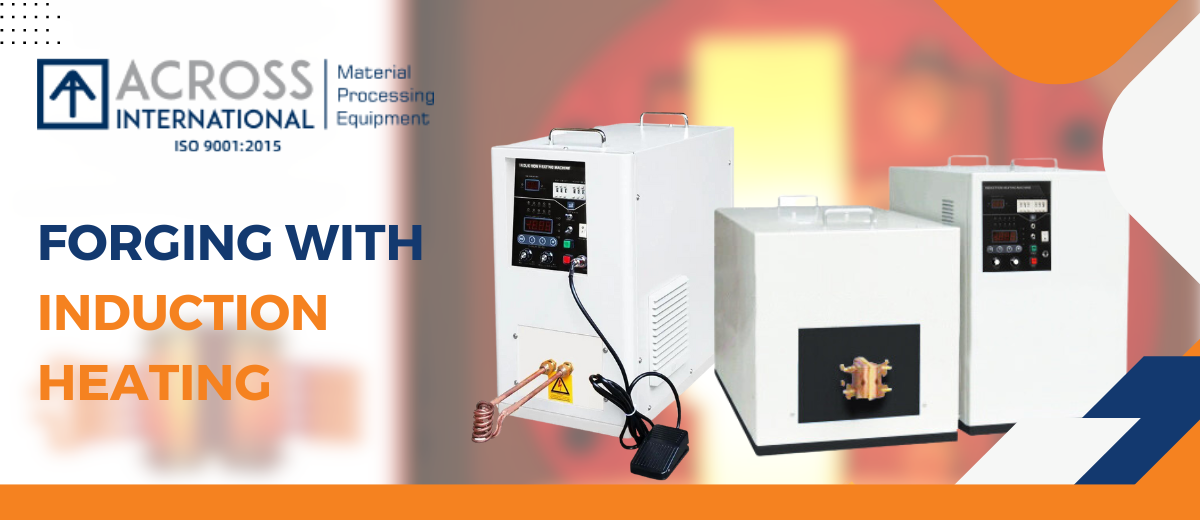
A superior alternative to furnace heating, induction heating provides faster, more efficient heat in forging applications. The process relies on electrical currents to produce heat within the part that remains confined to precisely targeted areas. High power density means extremely rapid heating, with exact control over the heated area. Recent advances in solid-state technology have made induction heating a remarkably simple and cost-effective heating method. Benefits of using Induction for forging are:
1. Rapid heating for improved productivity and higher volumes
2. Precise, even heating of all or only a portion of the part
3. A clean, non-contact method of heating
4. Safe and reliable – instant on, instant off heating
5. Cost-effective, reduces energy consumption compared to other heating methods
6. Easy to integrate into production cells
7. Reduced scaling
Across International delivers expertise, innovation, and system quality to give your company a competitive edge.
Across International offers Induction Heating equipment, power supplies & metal heating furnaces from 1kW to 500kW in output power and frequency ranges from 1kHz to 1 MHz.
We also offer induction heating equipment and high frequency induction furnace for curing adhesives. We are able to provide turn-key solutions from our standard product line and equipped with a induction heating for testing and developing solutions for our customer’s important processes