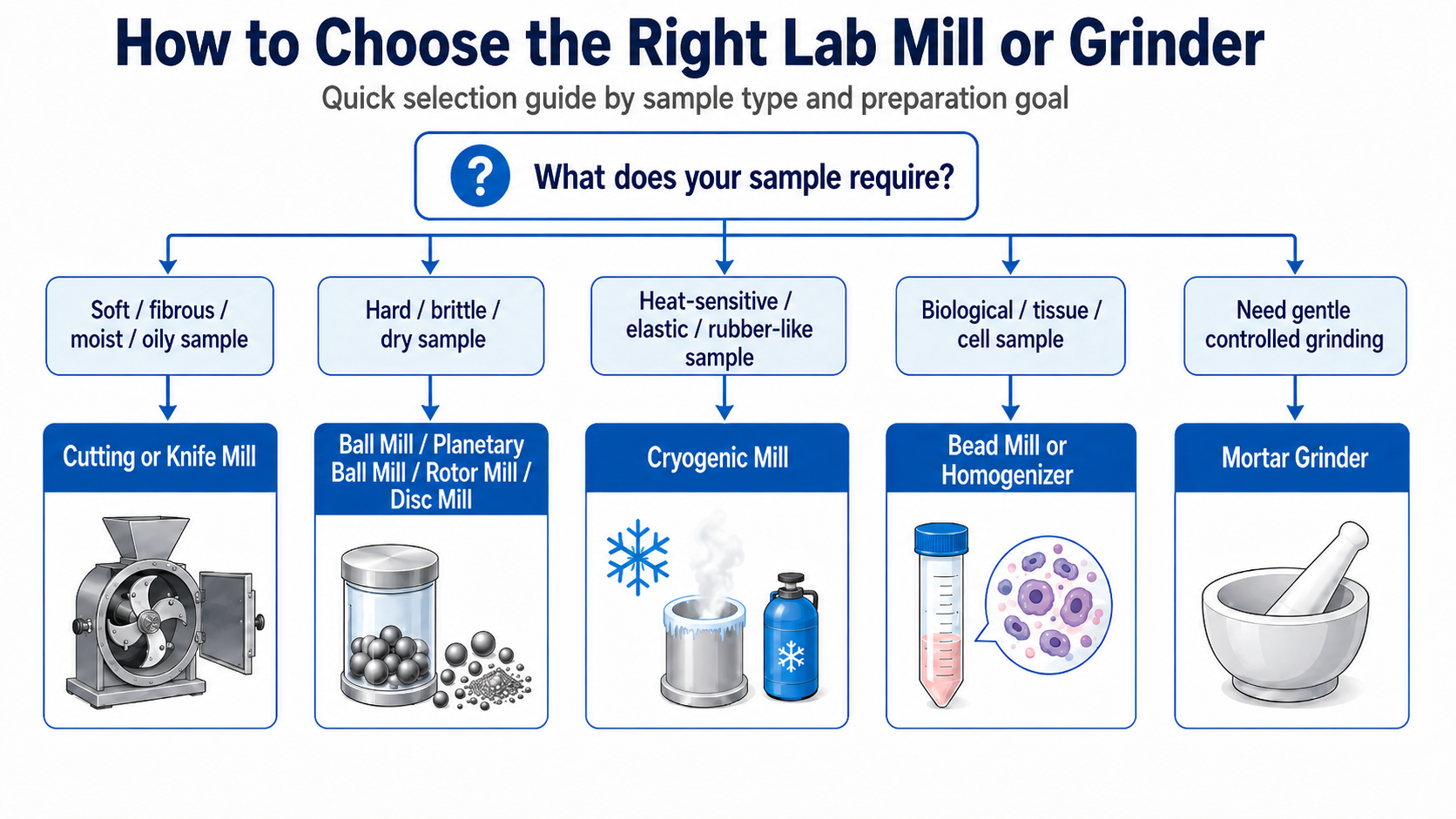

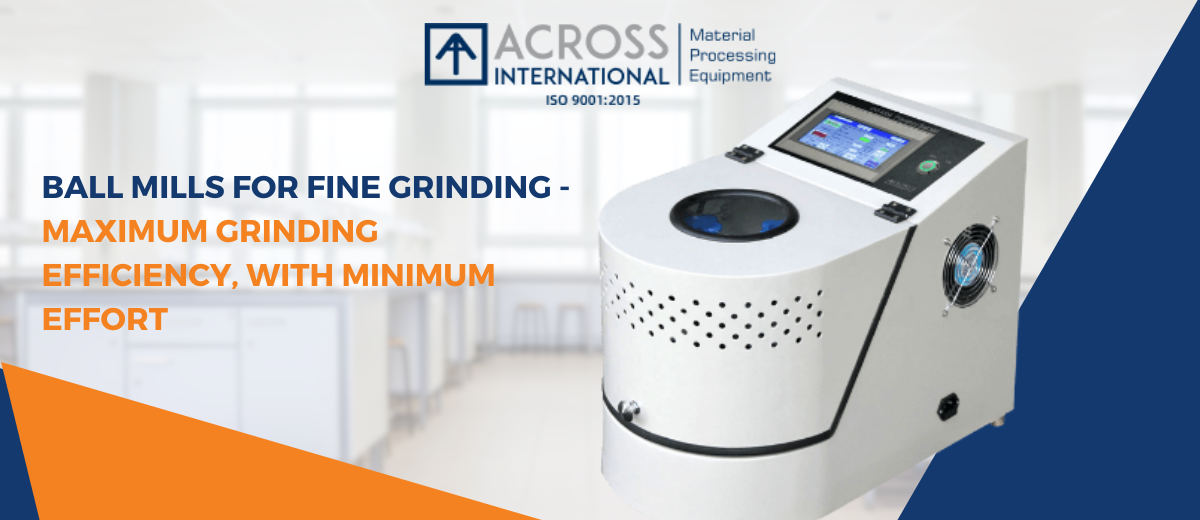
Across International offers the largest selection of laboratory ball mills in the market! Ball mills are among the most variable and effective tools when it comes to size reduction of hard, brittle or fibrous materials. The variety of grinding modes, usable volumes and available grinding tool materials make ball mills the perfect match for a vast range of applications.
Planetary Ball Mills :
In a planetary ball mill, each jar represents a “planet”. This planet is located on a circular platform, the so-called sun wheel. When the sun wheel turns, the jar rotates around its own axis, but in the opposite direction. Thus, centrifugal and Coriolis forces are activated, leading to a rapid acceleration of the grinding balls. The result is very high pulverization energy required to produce very fine particles. The enormous acceleration of the grinding balls from one wall of the jar to the other produces a strong impact effect on the sample material and leads to additional size reduction effects through friction.
For Ball milling and most other applications, the ratio between the speed of the sun wheel and the speed of the grinding jar is 1: -2. This means that during one rotation of the sun wheel, the grinding jar rotates twice in the opposite direction. This speed ratio is very common for Planetary Ball Mills in general. Planetary ball mills with higher energy input and a speed ratio of 1:-2.5 or even 1:-3 are mainly used for mechanochemical applications.
PLANETARY BALL MILLS - FIELDS OF APPLICATION
Planetary ball mills are used for the pulverization of soft, hard, brittle, and fibrous materials in dry and wet mode. Extremely high centrifugal forces result in very high pulverization energy and therefore short processing times.
Planetary ball mills are ideally suited for tasks in research like mechanochemistry (mechano-synthesis, mechanical alloying and mechanocatalysis), or ultrafine colloidal grinding on a nanometer scale, as well as for routine tasks such as mixing and homogenizing.
A crucial advantage of planetary ball mills is their great versatility. They are available with different numbers of grinding stations. Jars and balls are available in various sizes and materials.
PLANETARY BALL MILLS - GRINDING JAR AND BALL MATERIALS
HOW TO CHOOSE THE MOST SUITABLE MATERIAL
If, for example, a sample is analyzed for its heavy-metal content, the abrasion of steel grinding jar and balls might introduce chromium into the sample which would lead to falsified analysis results. Therefore, a metal-free material like zirconium oxide should be selected. Another point to consider is the influence of the tool on the grinding efficiency. Here two aspects are important:
Energy input (related to the density of the material)
Hardness of the material
ENERGY INPUT
The energy input grows with increasing density of a material. If the material of the grinding jars and balls has a high density, like tungsten carbide, acceleration of the grinding balls is higher at a given speed compared to materials of lower density. This means the energy input is higher when the ball hits the sample and, consequently, the crushing effect is higher with dense materials. This effect is beneficial for pulverizing hard-brittle samples.
For soft sample materials, on the other hand, too much energy input can prevent effective crushing. In such cases, the sample is not really pulverized into a fine powder but rather forms a layer that sticks to the jar walls and covers the grinding balls. Homogenization is not possible that way and sample recovery is difficult. For soft sample materials, other mill types, for example rotor mills, are better suited.
HARDNESS
To find a jar and ball material with suitable hardness, the consideration is simple: The material must be harder than the sample. If the material is less hard, the grinding balls could be ground by the particles of the sample material.
GRINDING TOOLS OF DIFFERENT MATERIALS
It is not recommendable to use tools of different materials, e. g. a jar made of steel used with balls made of zirconium oxide. First, abrasion from both materials will influence the analytical result, and second, wear of the tools is increased.
PLANETARY BALL MILLS - RECOMMENDED JAR FILLINGS
FOR DRY GRINDING
For dry grinding, the best results are usually obtained with the so-called one-third-rule. This means, that approximately one third of the jar volume should be filled with balls. Following this rule, the smaller the balls are, the more must be taken to fill a third of the jar. Another third of the jar volume should be filled with sample material. The remaining third is free space to allow the ball movement inside to achieve the required comminution energy for fast pulverization of the sample.
Following this rule, the required crushing energy is provided while at the same time sufficient sample material is in the jars to prevent wear.
FOR FIBROUS SAMPLES
For fibrous materials, or materials which lose their volume drastically when pulverized, a higher sample filling level is advisable. Sufficient material needs to be in the jar to minimize wear. If necessary, it is possible to add more material after a few minutes to maintain the minimum required volume.
FOR WET GRINDING
To produce particle sizes down to 100 nm or less, wet grinding and friction is required rather than impact. This is achieved by using many small balls with a large surface and many friction points. Consequently, the one third filling level, which is recommended for dry milling processes, is exchanged by the 60 % rule, meaning that 60 % of the jar are filled with small balls. The sample amount should be approx. 30 %. First, the small balls are added to the jars (by weight!) and then the material is added and mixed. Finally, the dispersant liquid is mixed carefully.
HOW TO CHOOSE THE CORRECT GRINDING BALL SIZE
Another rule , that the grinding balls should be at least three times bigger than the largest sample piece. In this way it is ensured, that the balls can pulverize the sample quickly.
To find the suitable ball size for the desired final fineness, usually a factor of approximately 1000 can be applied. If a grind size of 30 µm (D90) is the objective, the most suitable ball size would be between 20 mm and 30 mm. If smaller particles are required, the balls must be removed and replaced by smaller ones for a second process step.
As larger balls could crush smaller ones, it is not advisable to combine different ball sizes in one milling process.
WET AND NANOSCALE GRINDING IN PLANETARY BALL MILLS
Nanotechnology deals with particles in a range from 1 to 100 nm. These particles possess special properties due to their size, as their surface is greatly enlarged in relation to their volume (so-called “size-induced functionalities”). Ultrafine particles are, for example, harder and more break-resistant than larger particles.
With dry grinding the particle size of a sample can only be reduced to a certain extent as small particles tend to get charged on their surfaces and agglomerate. Therefore, liquid or dispersant is used to keep the particles separated. Salt solutions are used to neutralize the surfaces charges. Long chain molecules in the liquid can keep the particles separated thanks to steric hindrance.
Due to their significantly enlarged surface in relation to the volume, small particles are drawn to each other by their electrostatic charges. Neutralization of surface charges is only possible by adding a buffer (electrostatic stabilization, left) or by adding long-chained molecules (steric stabilization, right).
Request Complimentary Lab Testing Service :
We will design and test the optimal Ball Mill griding solution for your application .You need to buy grinding Jars for the testing . Request for Lab Testing.