

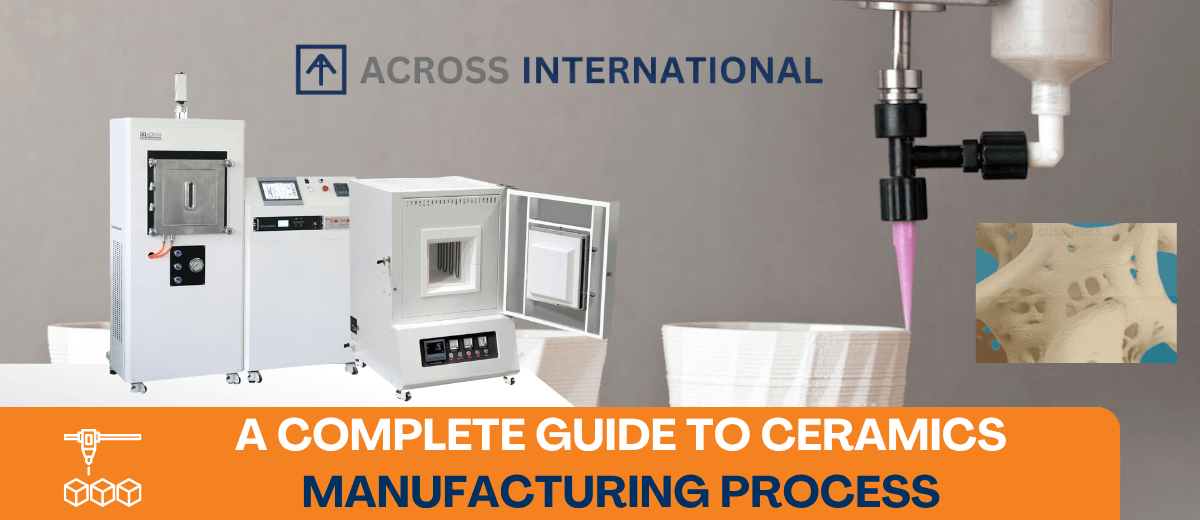
Ceramic manufacturing is a technique that involves the conversion of inorganic raw material into pure high-quality products. While technology has advanced, advanced ceramic processing has become a driving force in materials science innovation. Technical ceramics and industrial ceramic products have become essential materials in various industries. In this article, we discuss the modern manufacturing process of ceramics, what equipment is required to produce advanced ceramics and the challenges and future in ceramic manufacturing.
What is ceramic?
A ceramic is an inorganic, non-metallic material made from metallic and non-metallic elements bonded by ionic or covalent bonds. Ceramics can withstand high temperatures and maintain structural integrity under demanding conditions. In general, ceramics are hard and brittle, with limited plastic deformation.
The ceramics are divided into two kinds, conventional and advanced. For example, the conventional ceramics are made from clay and used to make tiles and bricks, and advanced ceramics consist of silicon carbide (SiC), alumina (Al2O3), and zirconia (ZrO2).
Types of ceramics
Understanding the different types of ceramics, and their unique properties, will help in identifying applications and usage. Generally, ceramic materials are divided into oxide and non-oxide categories. Metalloid and metallic oxides are categorized as oxide whereas carbides and nitrides are non-oxide ceramics. Non-oxide ceramics are harder and have better electrical conductivity than oxide ceramics.
|
Type |
Description |
Examples |
|
Traditional Ceramics |
Clay-based, fired at moderate temperatures. |
Pottery, porcelain, tiles, bricks |
|
Advanced Ceramics |
High-performance ceramics for industrial applications. |
Zirconia, alumina, silicon carbide, silicon nitride |
|
Structural Ceramics |
Provides mechanical strength and thermal resistance. |
Bearings, armor plates, turbine blades |
|
Bio-Ceramics |
Designed for biological compatibility. |
Bone grafts, hip replacements |
|
Electronic Ceramics |
Exhibit piezoelectric, dielectric, or magnetic properties. |
Capacitors, insulators, sensors |
|
Piezoelectric ceramics |
Converts properties into electrical signal |
ultrasonic power transducers, actuators for atomic force microscopes, motion sensors |
Key properties of ceramic materials
Electrical conductivity: The presence of the strongest bond, i.e. covalent bond, limits the movement of the free electron resulting in limited electrical conductivity. This feature makes ceramics useful as electrical insulators in a wide range of technological context. Their electrical resistivity can be carefully adjusted for semiconductors and electronic applications.
Thermal conductivity: Ceramics have been widely used as thermal insulators or resistance to high temperature due to their low thermal conductivity. Ceramics are suitable for use in engines and furnaces because they can withstand high temperatures despite having poor heat conductivity. Spacecraft ceramic tiles and furnace linings are examples of applications for ceramics because of their thermal characteristics.
Bond: Ceramics are connected by ionic and covalent bonds that help to make robust lattice structure. They have excellent chemical stability and can also resist deformation, which makes it suitable for severe situations.
Hazardous properties: Ceramics are known to be environmentally friendly because they do not emit any hazardous materials or produce any pollutants. Ceramics are inert, they can be used in industries with high hygiene standards, such as food processing and pharmaceuticals.
Density: Because of their density, ceramics are marked by their comparatively low weight and bulk, which lies between that of polymers and metals. This feature is crucial in such situations where reducing weight becomes quite beneficial. For example, ceramics are a very good material choice for aerospace applications because of their low density, which is crucial for balancing low weight and structural strength.
Corrosiveness: Ceramics are naturally resistant to environmental corrosion because of the chemical stability and lack of corrosiveness that are inherent in their atomic structure. These features make them applicable in areas where exposure to corrosive materials is a problem. In the presence of strong chemicals, ceramics can offer durable corrosion resistance.
Significant steps in ceramic manufacturing process
The process of ceramics manufacturing consists of various steps, each of which plays a crucial role in transferring raw material into pure and durable products. The following steps describe how ceramic is made:
1. Raw material extraction
Raw material collection is the first step in ceramic manufacturing. The most common raw materials are clay and kaolin.
2. Extraction processing
This step involves the reduction of raw materials into fine powders and can be achieved by using ball mills or jet mills. Also, the physical or chemical properties of the raw materials are improved by washing or separation process. This step ensures uniformity of particle size and removes impurities.
3. Forming
The prepared materials using the above step are shaped into required shape and size by using different methods such as injection molding, pressing etc.
4. Drying
After forming, the ceramic products are dried carefully to remove moisture which helps to prevent cracking during fire.
5. Glazing
Before sintering, this step is introduced to the process. Oxides make up the glaze, which gives the product the ideal final appearance. Both spraying and dipping techniques can be used to apply the glaze.
6. Sintering
The dried ceramic product is fired in a furnace at high temperature. In this process, the material solidifies, improving its durability and strength, and permanently harden and densify the material.
Manufacturing temperature of different industrial ceramics
The ceramic manufacturing temperature varies depending upon the type of ceramic needed to manufacture. Some of the different ceramics and the temperature required are as follows:
Silicon carbide ceramics: Known for very good heat stroke and are manufactured in the temperature range of 2200 - 2500°C. Applicable in high temperature furnaces.
Boron nitride ceramics: These ceramics have very good electrical insulation and thermal conductivity and are manufactured in the temperature range of 1900- 2300°C. Applicable in aerospace, semiconductor, and nuclear industries.
Mullite ceramics: Known for very little thermal expansion and elevated temperature strength, and manufactured in the temperature range of 1600-1800°C. Applicable in thermal insulation components, kiln furniture etc.
Alumina ceramics: Known for outstanding mechanical properties and electrical insulation and produced in the temperature range of 1600-1800°C. Applicable in electronics, automotive, and aerospace etc.
Zirconia ceramics: Such types of ceramics are known for very good resistance to cracking and can be manufactured in the temperature range of 1400-1600°C. Applicable in dental and medical devices.
Challenges in ceramic manufacturing
During ceramic manufacturing, some common challenges may need to be faced. They are:
- The control of homogeneity, size, and composition of the raw material
- Controlling the water content during drying
- Achieving uniform sintering temperature
- Achieving uniform shaping in the step of forming
The Future of Advanced Ceramics
- Ceramics are key materials for applications such as aerospace, semiconductors, energy generation, electronics, and industrial processing due to their significant features like heat and corrosion resistance, and excellent thermal property. The development in material science, technical innovation, manufacturing techniques, and investment in business have made ceramic material of choice in a wide range of applications.
- As the adoption of SiC and GaN increased, a bandgap of semiconductor materials and this could replace silicon as the semiconductor material of choice in many applications such as electric vehicle, electronic market, and power electronics, resulting in smaller size and more efficient as compared to silicon-based solutions. Also, the addition of graphene and nano oxide into ceramic has improved the thermal conductivity and toughness. Therefore, another area of innovation is flexible ceramics applicable in sensors and micro batteries. Also, the increasing demand for additive manufacturing, ceramic matrix composites etc. exhibiting the importance of ceramics as a promising material for future needs.
What equipment is necessary for creating ceramics?
Industrial ceramic production requires specialized machinery to handle every stage of the process. Each tool is critical to high-quality ceramics manufacturing and must be carefully maintained.
|
Equipment |
Purpose |
|
Grinds materials into fine powders. |
|
|
Mixing Blenders |
Ensure uniform composition. |
|
Compresses powders into shapes. |
|
|
Slip Casting Molds |
Used for hollow and complex forms. |
|
Remove water without warping. |
|
|
Glazing Booths |
Apply coatings to formed ceramics. |
|
Harden ceramics through high heat. |
|
|
Inspection Table |
Ensures dimensional and structural quality. |
What are the types of ceramic sintering furnaces?
- Vacuum furnaces: Works under vacuum and help to prevent oxidation
- Electric furnaces: Uses heating elements such as SiC or MoSi2. The most common method.
- Gas fired furnaces: Uses natural gas for heating sources.
- Micro-wave furnaces: Uses microwaves to heat the ceramic material directly. Applicable for rapid heating and sintering.
Choosing the right furnace for ceramic sintering
To achieve the desired product, choosing the right sintering furnace for ceramic manufacturing is crucial. The following are some guidelines to help you to choose the right furnace for your application.
- First, think about the type, size and volume of ceramic material you are going to sinter.
- Choose types of furnaces and the features provided by them such as heating elements, temperature range, atmosphere control, and heating and cooling rate based upon your requirement.
- Look for features such as overheating prevention, built in safety, and warranty.
- Think of your production volume and budget
- Consult with the expert in related field.
Need help choosing the right sintering furnace? Contact our experts today for tailored solutions!
Why Choose Across International Furnaces?
Across International (Ai Furnaces) is a trusted name in high-temperature processing, widely used in national laboratories, university laboratories, and production environments. When it comes to ceramics manufacturing, especially the critical furnace heat treatment phase (sintering), selecting the right furnace can define the quality, consistency, and performance of the final product. Here's why Across International furnaces are a strong choice:
High Temperature Capability
- Models up to 3500°C available
- Perfect for sintering alumina, zirconia, SiC, and other refractory ceramics
Programmable Precision
- Multi-segment controllers for advanced profiles
- PID feedback loops for temperature control
- Safety interlocks for real-time monitoring
- Inert gas compatibility (Ar, N₂, H₂)
- Vacuum-compatible versions for oxygen-sensitive materials
Perfect for Research & Scale-Up
- Benchtop and pilot-scale models
- Uniform thermal zones for reproducibility
- Configurable for experimental versatility or small-batch manufacturing
Across International Equipment for Ceramic Manufacturing
|
Furnace Type |
Model Series / Example |
Key Features |
Suitable Ceramic Processes |
|
Max 1800 °C, programmable PID, vacuum/inert gas options
|
General sintering, binder burnout, grain coarsening |
||
|
Horizontal/split, up to 1700 °C, multi-zone uniformity, gas-tight flanges |
Calcination, thermal oxidation, controlled atmosphere sintering |
||
|
Continuous powder processing, ideal for granules or flowable ceramics |
Reactive sintering, thermal processing of ceramic powders |
||
|
Fast Sintering Furnaces |
Rapid thermal cycling (up to 100 °C/sec), compact quartz chamber |
Thin films, coatings, electro ceramics |
|
|
Preheating Flash Sintering |
Preheat + electric field activation, MoSi₂ elements, vacuum/inert capable ≤200℃/s |
Ultra-fast densification, field-assisted sintering, SOFCs, high-performance ceramics |
|
|
SPS (Spark Plasma Sintering) |
Up to 2500°C temp up to 50T pressure |
Nanomaterials, conductive ceramics |
FAQs
What are the steps in the ceramic manufacturing process?
Ceramic manufacturing involves several key stages: raw material extraction, powder preparation, forming (pressing or casting), drying, glazing, and sintering. Each step plays a critical role in achieving the desired shape, strength, and performance of the final ceramic product.
What is sintering in ceramics?
Sintering is the process of heating shaped ceramic materials at high temperatures without melting them, to bond particles together. It increases density, strength, and durability, transforming the ceramic from a brittle green body to a hard, solid product.
What equipment is needed for ceramic production?
Essential equipment for ceramic production includes ball mills, powder mixers, molding presses, slip casting molds, drying ovens, glazing booths, and sintering furnaces (electric, gas, or vacuum). Quality control tools like inspection tables and thermal sensors are also crucial.
What are the types of ceramics and their uses?
There are traditional ceramics (like tiles and pottery), advanced ceramics (used in electronics, aerospace, and medical devices), structural ceramics (turbine blades, armor), and bio-ceramics (bone implants, dental devices). Each type offers unique thermal, electrical, or mechanical benefits.
What temperature is used to manufacture ceramics?
- Ceramic sintering temperatures vary by material:
- Alumina: 1600–1800°C
- Zirconia: 1400–1600°C
- Silicon carbide: 2200–2500°C
- Mullite: 1600–1800°C
- Boron nitride: 1900–2300°C
High-temperature furnaces are essential to reach and maintain these levels.
What raw materials are used in ceramic manufacturing?
Ceramic production uses naturally occurring raw materials such as clay, kaolin, feldspar, silica, and alumina. Advanced ceramics may also include synthetic materials like zirconia, silicon carbide, or boron nitride for specific industrial applications.
What is ceramic glazing and why is it important?
Glazing is the process of coating ceramics with a layer of glass-forming oxides. It improves the product's surface finish, provides water resistance, enhances aesthetic appeal, and can increase durability.
What is the difference between traditional and advanced ceramics?
Traditional ceramics are clay-based and commonly used for household goods and construction. Advanced ceramics are engineered materials used in high-performance applications like semiconductors, aerospace components, and biomedical devices.


