




Frequently Asked Questions
Got Questions? We’ve Got Answers
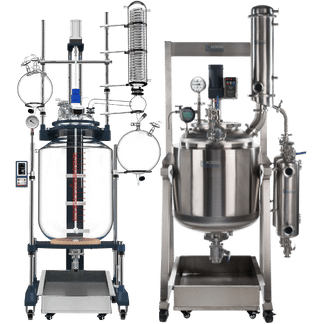
Reactors are controlled vessels designed to facilitate chemical reactions under controlled pressure, temperature, and mixing conditions. By connecting a glass reactor to external equipment such as heaters, chillers, vacuum pumps, and stirrers, researchers and industrial users are able to control every aspect of their experiment. They are widely used in research laboratories, chemical synthesis, crystallization, distillation, mixing, evaporation, and blending across the research, chemical, cannabis, and food industries for laboratory and industrial processing.
Normally, reactors are designed to process chemical reactions with temperature, air, and pressure control. A reactor consists of a lid that accommodates different accessories such as a condenser, pressure gauge, stirrer, and thermometer. Reactants and solvents are mixed and loaded into the glass reactor body, and the reaction process is monitored through transparent glass for real-time visual inspection.
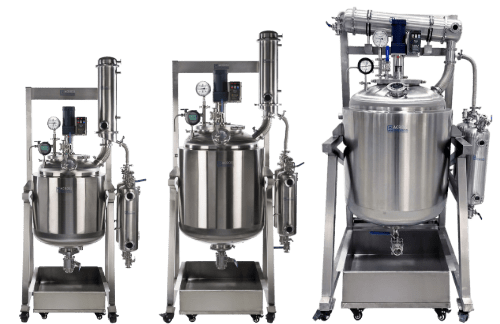
The most common types of reactors are glass reactors, stainless steel reactors, single-jacketed reactors, vacuum reactors, and dual-jacketed reactors. They are engineered and selected based on chemical compatibility, temperature, pressure, and application.
Glass reactors are generally made of borosilicate glass and offer chemical inertness and good visibility, making them ideal for corrosive and high-purity applications, whereas stainless steel reactors feature excellent mechanical strength, the ability to withstand high temperature and pressure, and durability.
The limitations of glass reactors compared to stainless steel include sensitivity to thermal shock, fragility, and unsuitability for high-temperature and pressure applications. Also, borosilicate glass reactors are vulnerable to strong alkalis, hot phosphoric acid, hydrogen fluoride (HF), and strong alkalis such as KOH and NaOH.
Glass reactors are the best option when you need real-time visualization of chemical reactions, need to process corrosive chemicals such as acids, and in some special cases where contamination must be avoided.
Stainless steel reactors are durable, resistant to pressure, suitable for large-scale production, and provide superior thermal conductivity for heating and cooling.
You should choose stainless steel reactors when your application requires high pressure, high temperature, and a large-scale industrial process where safety, strength, and durability are crucial.
For botanical/cannabis extraction, both types of reactors can be used, but it depends on the application and chosen method. Generally, jacketed closed loops and agitated reactors made of glass or stainless steel are used for refining processes such as crystallization, winterization, and decarboxylation.
The best stirring system depends on the scale and viscosity of the application, but overhead mechanical stirring is the most commonly used option for reactors due to its ability to provide consistent mixing, effectively handle high-viscosity materials, and offer better control and durability compared to magnetic stirring.
The common materials used for reactor seals and gaskets are polytetrafluoroethylene (PTFE), silicone, and fluoroelastomer (Viton). PTFE is the most widely used material to seal reactors, silicone is preferred for food/pharma applications, and Viton is used for high-temperature elastomeric seals.
Thermal shock in glass reactors can be prevented by avoiding rapid temperature changes. Always heat or cool the reactor gradually, use a proper temperature control system, and ensure uniform heating or cooling throughout the reactor vessel to prevent thermal shock.
Across International offers various types of glass and stainless-steel reactors designed to support laboratory research through full-scale industrial production. Our glass reactors are available in sizes from 2L to 200L, and stainless-steel reactors typically range from 5L to 500L. All systems can be customized to meet application requirements and compliance standards.
-
 Trusted ISO 9001 Manufacturer ISO/IEC 17025:2017 certified calibration lab
 -
Trusted by 100K Universities & Companies Over 1000+ Scientific Papers Cited
-
12-hour Technical Support Available Mon–Fri, 8 AM to 8 PM & In-house testing
-
Price Match Matches qualified U.S. competitor prices


