



We use cookies to make your experience better. To comply with the new e-Privacy directive, we need to ask for your consent to set the cookies. Privacy Policy.
Vacuum Carbon Tube Sintering Furnace (Call for Pricing)
Price $0.00
CUSTOMIZE YOUR PRODUCT

Product Video
|
Call for Pricing



VCTF Serie is widely used in in the manufacturing of ceramics, optical materials, carbon composite materials, cemented carbide, powder metallurgy sintering under high temperature and vacuum condition with an option for gas protection if required.
Structure
- Chamber:Double-Layered Water Interlayer structure, inner layer with polished stainless steel(1Cr18N9Ti), and with an outer layer of carbon steel. The upper and lower flanges are welded into a cylindrical structure. Vacuum sealed with "O" ring with water cooling.
- Vacuum System: One diffusion pump with cold trap and one Mechanical pump
- Temperature Control System:Eurotherm 3504 Controller,500 Segment temperature control with P.I.D
- Gas Flow:One air inlet and one air outlet, Gas controlled atmosphere.
- Water-Cooling System:Built-in alarm and safety feature to cut off power in the event of a loss in water flow.
- Heating Elements and Heat Shields:The heating elements are made of electrode graphite and machined into a cylindrical structure,The heat shield is 80 mm thick, and composed of stainless steel, carbon felt, graphite cylinder. The heat shield provides thermal insulation, uniform heating, large radiation surface, as well as thermal shock resistance.


VCTF Specs
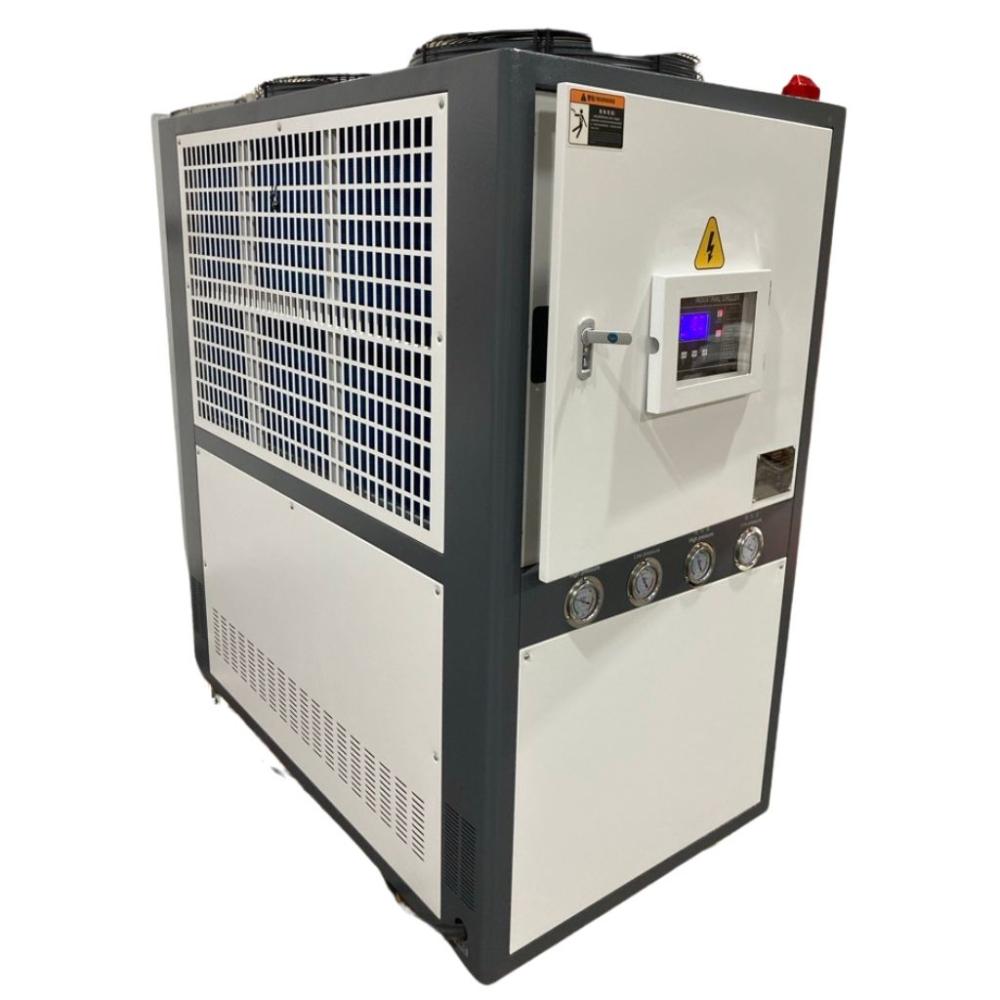
Optional Water Chiller Specs
| ||||||||||||||||||||||||||||||||||||||||||||||||||||||||||||||||||||||||||||||||||||||||||||||||||||||||||||||||||||||||||||||||||||||||||||||||||||||||||||||||||||||||||||||||||||||||||||||||||||||||||||||||||||
Frequently Asked Questions
What is a vacuum carbon tube sintering furnace used for?
A vacuum carbon tube sintering furnace is a type of tube furnace in which the heating zone is formed by a graphite, or carbon, tube and the entire system operates under vacuum or an inert gas atmosphere. These furnaces are used for sintering ceramics, metals, and carbon-based materials because they provide good temperature uniformity and a controlled processing environment. However, graphite components can introduce carbon contamination, making these furnaces less suitable for ultra-high-purity applications compared with tungsten-based furnaces.
What are the installation requirements for this furnace?
The furnace requires a stable power supply, gas supply if using an inert atmosphere, a suitable cooling system, and proper ventilation depending on the setup.
Why does my furnace not reach the desired vacuum or atmosphere condition?
This is often due to leaks, seal wear, gas-flow issues, vacuum pump performance, contaminated chamber surfaces, or improper gas purging. Regular inspection, leak checking, and preventive maintenance are recommended.
What are common issues during carbon tube sintering?
Common issues during carbon tube sintering include carbon contamination, where carbon from the graphite heating element or furnace components can diffuse into the sample and change the material’s properties, especially in sensitive metals. Oxidation of graphite components is another concern if vacuum or inert gas control is inadequate.
When should I choose a carbon tube furnace instead of a tungsten furnace?
You should choose a carbon tube furnace instead of a tungsten furnace when your process does not require ultra-high purity and can tolerate some carbon interaction or carbon exposure. Carbon tube furnaces are often a better choice for ceramic sintering and carbon-based materials, such as graphene, carbon nanotubes, and composites.
What are the advantages of a carbon tube furnace?
Carbon tube furnaces offer good temperature uniformity, flexible atmosphere control, and a lower cost compared with ultra-high-temperature tungsten furnaces.
What kind of atmosphere does a carbon tube furnace provide?
Generally, carbon tube furnaces provide a vacuum or controlled inert atmosphere to protect materials at high temperatures. They can operate under vacuum or with inert gases such as argon or nitrogen, providing a controlled environment for sensitive materials.
What temperature range can a carbon tube sintering furnace reach?
Depending on the quality of the graphite heating element and the furnace design, carbon tube sintering furnaces can typically reach temperatures from 1200°C to 2200°C.
What materials can be processed in a carbon tube furnace?
A carbon tube furnace can process a wide range of materials that are stable in vacuum or inert atmospheres, particularly materials that are not sensitive to carbon contamination. Common materials include ceramics, such as alumina, zirconia, and silicon carbide; metal powders and alloys, including iron-, nickel-, and cobalt-based systems; and carbon-based materials, such as graphene, carbon nanotubes, and composites. It is also widely used for powder sintering, annealing, calcination, and thermal decomposition of various compounds. However, it is generally not suitable for materials that react with carbon or require ultra-high-purity processing conditions, such as certain refractory metals and semiconductor-grade materials.
What should I consider before buying a carbon tube sintering furnace?
Before buying a carbon tube sintering furnace, you should evaluate how well the system matches your process requirements, whether your materials can tolerate carbon exposure, the size of the heating zone relative to your samples, atmosphere control needs, and temperature range.
Overview
Call for Pricing
VCTF Serie is widely used in in the manufacturing of ceramics, optical materials, carbon composite materials, cemented carbide, powder metallurgy sintering under high temperature and vacuum condition with an option for gas protection if required.
Structure
- Chamber:Double-Layered Water Interlayer structure, inner layer with polished stainless steel(1Cr18N9Ti), and with an outer layer of carbon steel. The upper and lower flanges are welded into a cylindrical structure. Vacuum sealed with "O" ring with water cooling.
- Vacuum System: One diffusion pump with cold trap and one Mechanical pump
- Temperature Control System:Eurotherm 3504 Controller,500 Segment temperature control with P.I.D
- Gas Flow:One air inlet and one air outlet, Gas controlled atmosphere.
- Water-Cooling System:Built-in alarm and safety feature to cut off power in the event of a loss in water flow.
- Heating Elements and Heat Shields:The heating elements are made of electrode graphite and machined into a cylindrical structure,The heat shield is 80 mm thick, and composed of stainless steel, carbon felt, graphite cylinder. The heat shield provides thermal insulation, uniform heating, large radiation surface, as well as thermal shock resistance.
Check items to add to the cart or
-
![1200°C PE/CVD Furnace w/ RF Generator, Gas Mix & Pumping System]() 1200°C PE/CVD Furnace w/ RF Generator, Gas Mix & Pumping SystemPrice $5,990.00
1200°C PE/CVD Furnace w/ RF Generator, Gas Mix & Pumping SystemPrice $5,990.00 -
![Ai 500 Watts 13MHz RF Generator for Up To 150mm Tube Furnaces]() Ai 500 Watts 13MHz RF Generator for Up To 150mm Tube FurnacesPrice $13,990.00
Ai 500 Watts 13MHz RF Generator for Up To 150mm Tube FurnacesPrice $13,990.00 -
![1700°C CVD Tube Furnace with Gas Mixing & Pumping System]() 1700°C CVD Tube Furnace with Gas Mixing & Pumping SystemPrice $12,990.00
1700°C CVD Tube Furnace with Gas Mixing & Pumping SystemPrice $12,990.00 -
![Digital Multi-Channel Gas Mixing System w/ Touch Screen Control]() Digital Multi-Channel Gas Mixing System w/ Touch Screen ControlPrice $6,490.00
Digital Multi-Channel Gas Mixing System w/ Touch Screen ControlPrice $6,490.00 -
![Muffle Furnace]() 1200C Controlled Atmosphere Muffle Furnace ETL/CE CertifiedPrice $7,990.00
1200C Controlled Atmosphere Muffle Furnace ETL/CE CertifiedPrice $7,990.00 -
![1400°C CVD Tube Furnace with Gas Mixing & Pumping System]() 1400°C CVD Tube Furnace with Gas Mixing & Pumping SystemPrice $7,990.00
1400°C CVD Tube Furnace with Gas Mixing & Pumping SystemPrice $7,990.00